The Cursor context window and your usage: two gauges, no link
By Christophe Paka · Facts checked on 7 November 2026
You watch a long chat fill up and think your plan is running out. Or your usage page shows plenty left, so you paste in more files. Readers mix the two all the time. One wrote: "I wish I had known earlier that Cursor sends the entire thread history with every request."
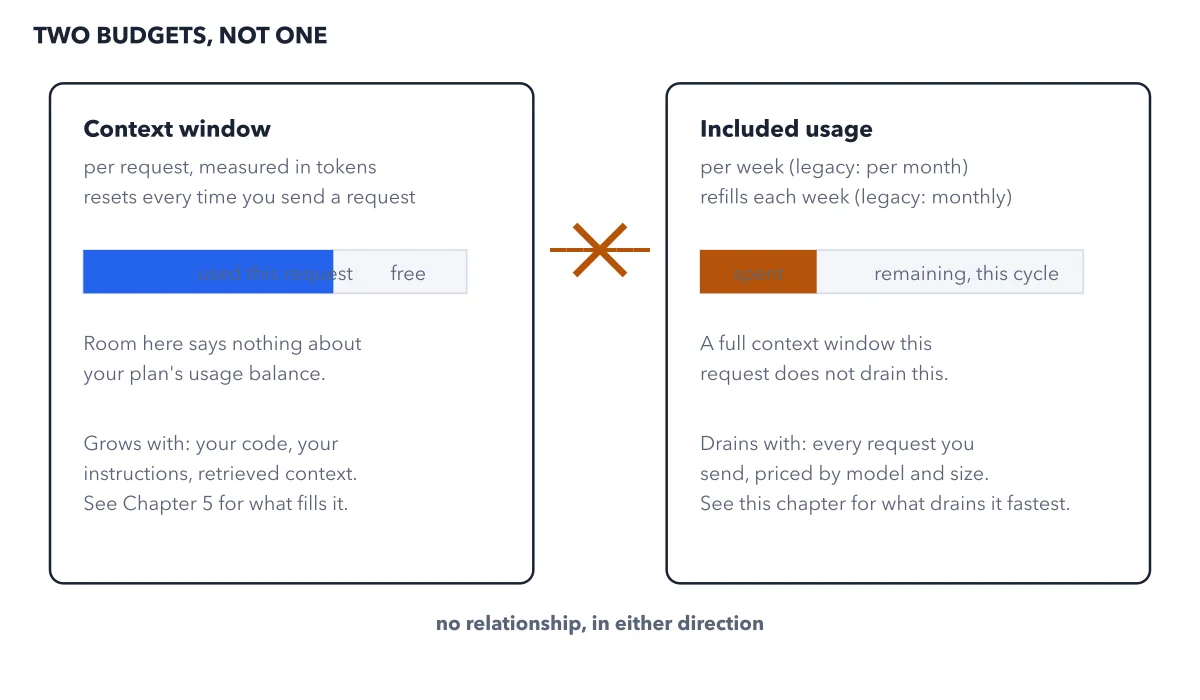
The Cursor context window and your plan's usage are two separate gauges. Read one as the other and you either panic early or let one long chat drain your meter. The figure draws both side by side, with a struck through arrow between them.
How to read this figure
Read the left gauge: the context window. The context window is how much text one request can hold, measured in tokens. A token is a small chunk of text, about three quarters of a word. The window holds your question, the files sent with it, your rules and the chat so far. It resets every time you send a request.
Read the right gauge: included usage. Included usage is what your plan pays for. On the new plans it is a weekly pool that refills each week; on legacy plans it is monthly. It drains with every request you send, priced by model and size. For the legacy version, see one legacy billing cycle.
Look at the crossed out arrow. The arrow between the gauges is struck through: no relationship, in either direction. Room in the context window says nothing about your plan's balance. A full context window on one request does not drain the right gauge by itself.
Find the one link: your habits. The model keeps no memory, so each new message in a chat carries the whole chat so far. A long chat is a full context window, sent again and again, and every sending draws on a meter. So the gauges stay separate, but a long chat moves the right one fast.
Key takeaways
- Judge what your plan has left on the usage page, never by how full a chat feels.
- Start a fresh chat when the task changes, and carry over only a short summary.
- Name only the files a task needs with @, so each request stays small.
Worked example: one long chat against one big request
The book follows Shelf, its example project, through one week on Claude. Two days show the difference between a big request and a long chat.
- Monday: one planning request sends 200,000 tokens in and gets 20,000 out. That is a big context window, sent once.
- Wednesday: one long chat of 40 messages. Each message carries the chat so far, about 30,000 tokens per request.
- No Wednesday request comes close to Monday's size, so the left gauge never looks alarming.
- But 40 sendings of 30,000 tokens add up to more than a million input tokens, all paid from the meter.
- Wednesday costs almost five times as much as Monday, because the chat went out again with every message.
Result: The smaller requests cost more, because there were 40 of them. A short new chat started from a summary would cost a small part of that.
Questions readers ask
Does a bigger context window use more of my Cursor plan?
Not by itself. The context window is the size of one request, and it resets every time. Your plan's usage drains with each request, priced by model and size. What costs you is sending a big request many times, and that is what a long chat does.
Why does a long chat drain usage faster than a short one?
Because the model keeps no memory. Each new message carries the conversation so far, so a long chat sends its whole history again with every message. Forty messages of 30,000 tokens each send more than a million tokens. Start a fresh chat from a short summary instead.
Does more context give better answers?
Not past what the task needs. Old turns, dropped ideas and wrong guesses stay in the request and compete with the facts that matter. A good sign that a chat has run too long: the agent repeats an idea you already rejected.
Sources: Models and pricing (Cursor docs); Usage limits (Cursor help).
This figure is from Cursor Made Crystal Clear, chapter 4.
The chapter builds the idea step by step, with recipes you can follow, a Try it to check yourself, and every source.
Get the book