Jev Made Crystal Clear · chapter 1: Why Jev: Decide, Don't Generate
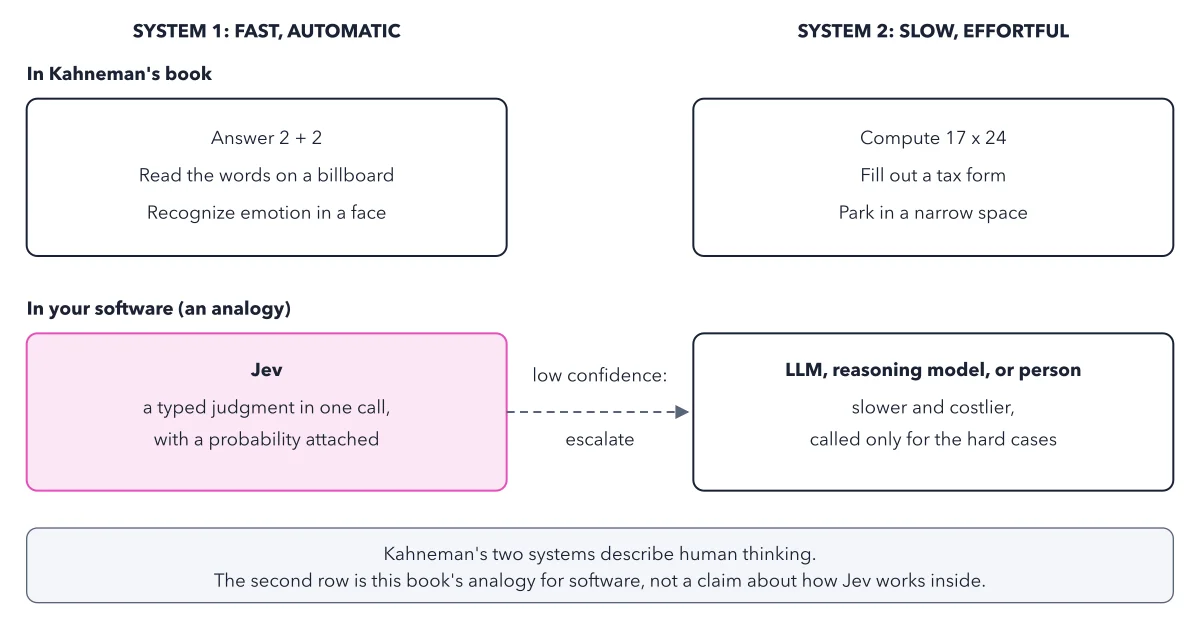
System 1 and System 2, with Kahneman's own examples in the top row and the software...
2026-09-10
The bottom row is an analogy, not an architecture.
Below: the paragraph from the book that builds this idea, then the diagram itself (Figure 1.2), and a recap. About a minute of reading.
TypeSafe's docs make the borrowing explicit and then narrow it: "Here, the emphasis is on fast, focused judgments." A System One model, in TypeSafe's definition, is "a class of AI models built to make fast, structured decisions that software can use directly." The useful part for a builder is the second row of Figure 1.2. Most of the decisions in a production pipeline are System 1 shaped: quick, repeated, with the possible answers known in advance. A few are not. Jev plays the fast lane, and when it is unsure, your code hands the case to the slow lane: an LLM, a reasoning model, or a person. The docs describe exactly that escalation, to "a person or a reasoning model", when confidence is low.
Recap
- The idea: The bottom row is an analogy, not an architecture.
- The picture: Figure 1.2, from chapter 1 ("Why Jev: Decide, Don't Generate") of Jev Made Crystal Clear.
- Go deeper: the chapter builds this step by step, with recipes and sources at the end.
This diagram is one of many in Jev Made Crystal Clear.
Every chapter opens with the gist, draws the hard ideas, and ends with recipes and sources.
Get the book