Mistral cost per task: when the higher rate costs less
By Christophe Paka · Facts checked on 22 October 2026
Mistral is a French AI company. Its Studio API lets programs use its models, and it bills by the token, a small piece of text. This page answers one question: which of two models costs less for the same job?
One model charges less than half as much per output token, so it looks like the easy pick. Then its answers run four times longer. A rate is not a bill: a wordy model writes more tokens, and you pay for every one.
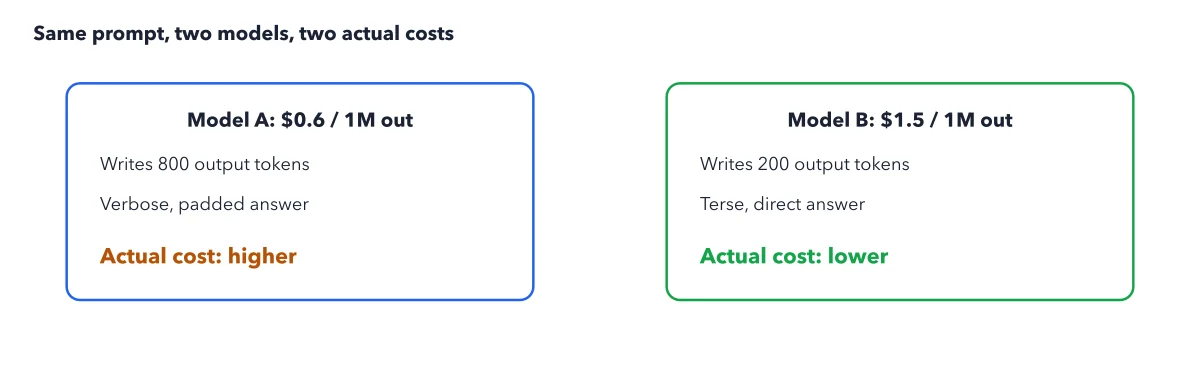
The figure below shows Mistral cost per task for one prompt on two models. Cost per task is what one finished answer costs. If you only chat in Vibe, Mistral's app, you pay a flat monthly fee instead, so this sum is for API users.
How to read this figure
Read the two rates on top. The boxes are labelled only Model A and Model B, so the drawing teaches the idea, not a pick. The rates are real ones: the chapter says $0.6 is Small 4's output price and $1.5 is Large 3's, both from Mistral's Pricing page. Output is the text the model writes back. On the rate card, A looks like the cheap choice.
Count Model A's tokens. Model A writes a verbose, padded answer of 800 output tokens. The box prints the word higher, not a dollar sum, so here is the book's sum. Multiply 800 tokens by $0.6, then divide by one million. That one answer costs $0.00048.
Read Model B. Model B charges $1.5 per million, more than twice as much. But it writes a terse, direct answer of 200 tokens. The same sum: 200 times $1.5, divided by one million. That answer costs $0.0003.
Compare the two results. Model B's answer costs less, although its rate is higher. It wins by writing a quarter of the tokens. The 800 and 200 are the book's example lengths; your own replies give your real counts. Reasoning makes the gap wider, because a model that thinks step by step writes its steps as output tokens.
Key takeaways
- Measure cost per task from the usage in real replies on two models before you choose.
- Compare models with your own prompts, not with a blended price from a benchmark site.
- Watch answer length: a model that writes less can beat a lower rate.
Try this: price one real task from its token counts
You need either a working API call, as in the book's first request recipe, or just a calculator. No code? Skip to step 3 and use the book's numbers: 1,500 tokens in and 400 out on Small 4. The models are in the post on the Mistral model lineup, and the prices on Mistral's pricing page.
- Send one real prompt, such as a client email to answer, to a model ID with a date in it. A dated ID always calls the same model version.
- Read
usagein the reply your program gets back: the part that counts the tokens. It holds the tokens you sent (input) and the tokens the model wrote back (output). The book's quickstart prints only the answer; showing usage is a one line change. - Multiply input tokens by the input price and divide by 1,000,000. Do the same for output, then add the two.
- Repeat with the same prompt on a second model, and compare.
Expected result: Two costs per task, and the cheaper one. A draft with 1,500 tokens in and 400 out on Small 4 costs $0.000225 plus $0.00024, so $0.000465, about five hundredths of a cent.
Questions readers ask
How do I work out the cost of one Mistral API call?
Take the token counts from usage in the reply. Multiply input tokens by the input price per million, and output tokens by the output price per million, dividing each by 1,000,000. Add the two. That is the cost per task.
What is a blended price?
One price per million tokens that mixes input and output at a fixed ratio. Benchmark sites use it to rank models. Your own mix of input and output decides your real cost, so trust your own cost per task over a blended price.
Why does reasoning raise the cost of an answer?
A model that reasons step by step writes its steps as output tokens, and output is the expensive side. Each step adds to the cost of every answer. Check usage in a real reply to see how many tokens the steps took.
Do I pay per task if I only use the Vibe app?
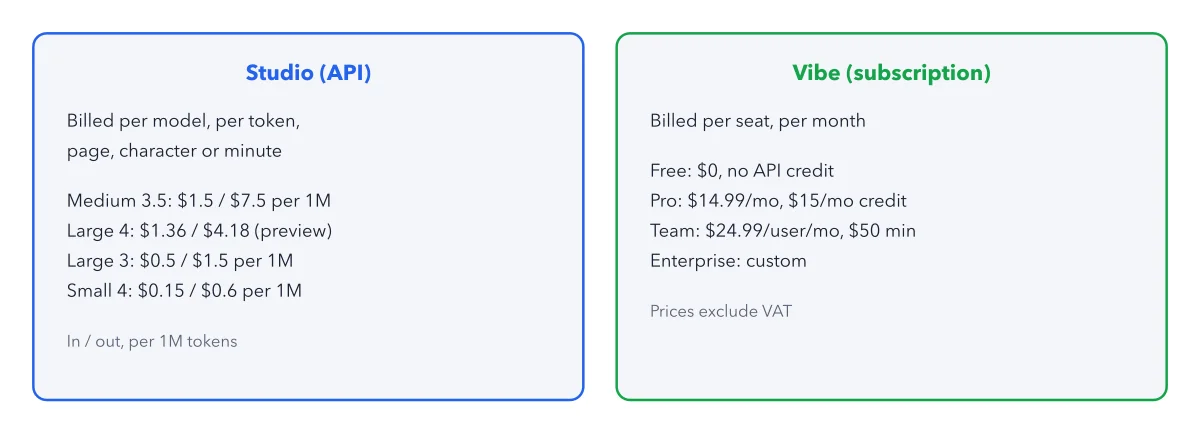
No. In the Vibe app you pay per seat each month, not per token. Pro costs $14.99 a month before VAT and comes with $15 a month of API credit. That credit is spent at the same token rates as this page, so the cost per task sum only matters once you call the API.
Sources: Pricing (Mistral docs).
This figure is from Mistral Made Crystal Clear, chapter 5.
The chapter builds the idea step by step, with recipes you can follow, a Try it to check yourself, and every source.
Get the book