Vapi endpointing: how the agent decides you stopped talking
By Christophe Paka · Facts checked on 7 November 2026
A builder posts that his agent feels rude. Older callers pause mid sentence for two or three seconds, and the agent jumps in. Callers repeat themselves, get cross, and hang up.
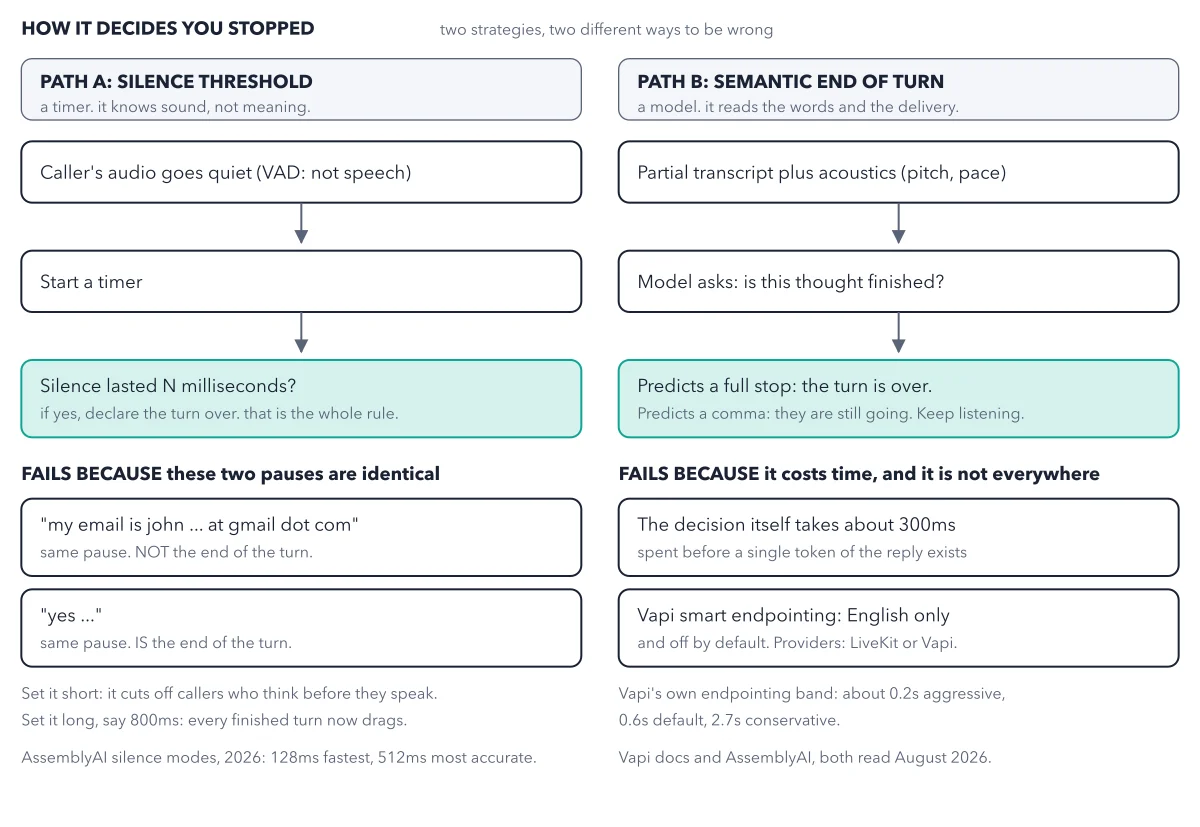
The fault is not the model. It is Vapi endpointing, the decision that the caller has finished speaking. There are two ways to make that call, and each one is wrong in its own way. The figure below sets them side by side, so you can see which failure you are hearing.
Use this diagram on your site
Free to share in your blog post, docs, course or slides, as long as the credit link stays. Paste the code below where the figure should go.
How to read this figure
Read path A from the top. Path A is a silence threshold. Voice activity detection (VAD), software that decides whether a sound is speech or noise, hears the audio go quiet. A timer starts. If the silence lasts long enough, the turn is over. That is the whole rule: it knows sound, not meaning.
See why path A fails. The pause in "my email is john ... at gmail dot com" is not the end of a turn. The pause after "yes" is. Both pauses are the same length, so no timer can tell them apart. Set it short and it cuts off callers who think; set it long and every turn drags.
Read path B from the top. Path B is smart endpointing: a model reads the partial transcript and the delivery, pitch and pace, and asks whether the thought is finished. If it predicts a full stop, the turn is over. If it predicts a comma, it keeps listening.
See why path B fails. The decision itself takes about 300 milliseconds, spent before the reply starts. Vapi offers two models for it: one from LiveKit, another voice agent company, recommended for English and only available in English, and Vapi's own model for other languages. Smart endpointing is off on a new assistant, so unless you switch it on under Start Speaking Plan on the Advanced tab, a timer decides.
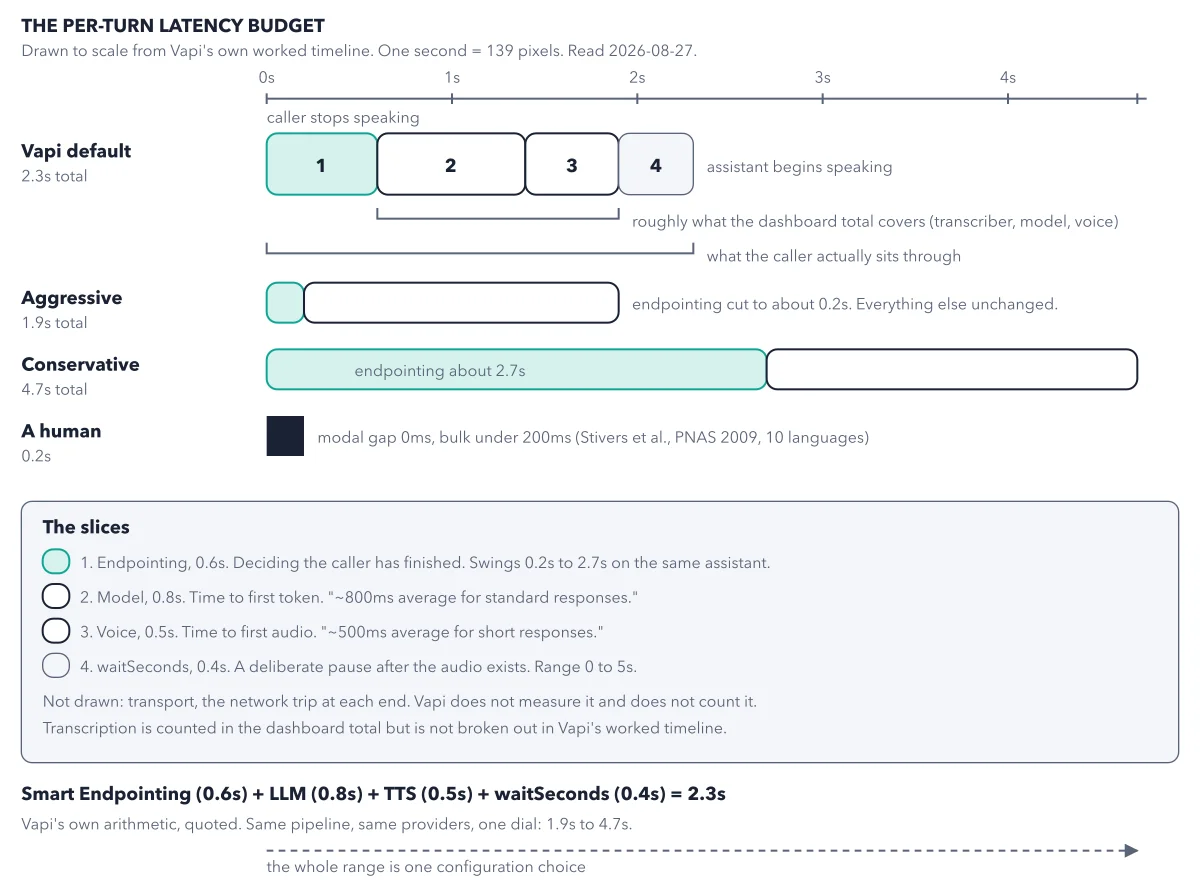
Note Vapi's band at the foot. Vapi's own endpointing band runs from about 0.2 seconds (aggressive) through 0.6 (the default) to 2.7 (conservative), on the same assistant. That swing is the same dial drawn in the latency budget of one turn: too rude at one end, too slow at the other.
Key takeaways
- Play the recording and name the fault, cut off or long gap, before you change any setting.
- Set the wait per moment: patient after questions that need thought, quick elsewhere.
- Outside English, tune the transcriber's three timers (after a full stop, with no punctuation, after digits) instead of LiveKit.
Worked example: the address that gets cut in half
Ava, the agent in the book, asks a caller for the address. She has no smart endpointing, so the transcriber's three timers decide. They set how long to wait after the last word: 0.1 seconds after a full stop, 1.5 seconds when there is no punctuation, and 0.5 seconds after digits.
- An older caller says "Twelve", pauses two seconds to remember, then says "Ash Lane".
- The transcriber writes "Twelve." with a full stop, so the full stop timer applies: Vapi waits 0.1 seconds. Then the set pause before every reply adds 0.4. That pause is called
waitSeconds. - Half a second into the pause, Ava says "Sorry, I didn't catch the street." Had the transcriber written no full stop, the 1.5 second timer would still end the turn before the two second pause is over.
- Fix one: a custom rule that waits 3.0 seconds after the agent says "phone", "email" or "address", as in Vapi's own example. Fix two: smart endpointing, which reads "Twelve" as unfinished. Fix three: ask for the house number and the street in two turns.
Result: Any of the three fixes lets the caller finish. The custom rule changes the wait only where callers think, so the rest of the call stays quick. All three live under Start Speaking Plan on the assistant's Advanced tab.
Questions readers ask
Why does my voice agent interrupt older callers?
They pause longer than the rule allows. A two or three second pause beats every default. Fix it where it matters: a custom rule for the question that needs thought, the conservative setting, or a longer wait when the transcript has no punctuation.
Is smart endpointing on by default in Vapi?
No. It is off on a new assistant. With neither a custom rule nor smart endpointing set, Vapi uses the transcriber's own end of turn detection. Check Start Speaking Plan on the Advanced tab to see which one decides yours.
Which endpointing rule wins in Vapi?
Vapi checks them in a fixed order. Your custom rules win when they match. Otherwise the smart endpointing plan runs, if you set one. With smart endpointing off, the transcriber decides.
What are the three endpointing timers in Vapi?
They are the transcriber's waits after the last word. After a full stop, Vapi waits 0.1 seconds. When the transcriber is unsure and writes no punctuation, it waits 1.5. After digits it waits 0.5, because people read numbers in chunks. In the settings they are onPunctuationSeconds, onNoPunctuationSeconds and onNumberSeconds. For card numbers, add a custom rule.
Sources: Speech configuration: start and stop speaking plans (Vapi docs); Voice pipeline configuration (Vapi docs); How intelligent turn detection works (AssemblyAI).
This figure is from Vapi Made Crystal Clear, chapter 5.
The chapter builds the idea step by step, with recipes you can follow, a Try it to check yourself, and every source.
Get the book