Does ChatGPT learn from my chats? Training and inference
By Christophe Paka · Facts checked on 23 October 2026
You correct the AI on Monday. On Tuesday it makes the same mistake. Or the reverse: it seems to remember something you said weeks ago, and you wonder what it keeps. Both feel like learning, and neither is.
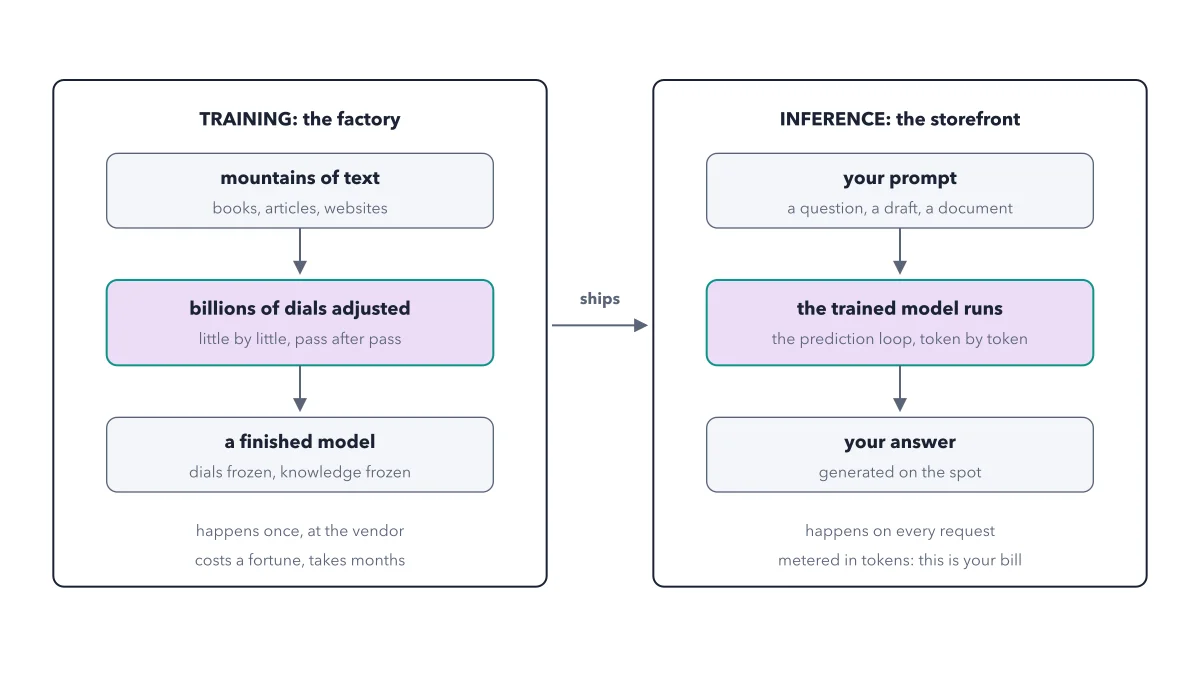
If you assume the model learns from you, you will skip the step that makes it right: handing it the facts each time. So, does ChatGPT learn from my chats? The model does not. Its life has two phases, and the figure below puts them side by side: the factory where it learns once, and the storefront where it answers and learns nothing.
How to read this figure
Start in the factory on the left. Training feeds mountains of text, books, articles and websites, into billions of dials. The dials are adjusted little by little, pass after pass, until the model's guesses match the patterns in that text.
See the dials freeze. Training produces a finished model with its dials frozen and its knowledge frozen. It happens once, at the vendor, costs a fortune and takes months. The date the data ends is the knowledge cutoff.
Follow the ships arrow. The finished model ships to the storefront. From here on, nothing in the dials changes, whatever you type.
Read the storefront on the right. Inference is using the finished model. Your prompt, a question, a draft or a document, goes in; the model runs the prediction loop token by token and returns an answer generated on the spot.
Read the meter. Inference happens on every request and is metered in tokens. This is your bill: longer requests and longer answers cost more. The training cost sits inside the vendor's prices.
Key takeaways
- Assume nothing you type teaches the model; hand it the facts newer than its cutoff every time.
- Use a business plan for work data: its default is no training on your chats, written into the contract.
- Budget for inference: every request is counted in tokens, so long prompts and long answers cost more.
Worked example: the policy change the model never saw
Your company changed its refund policy yesterday. A colleague asks the AI app about refunds.
- The model's dials froze at its cutoff, before the change, so the new policy is invisible to it.
- Telling it the new policy in one chat does not move a dial. A new chat starts from the same frozen model.
- Pasting the policy into the prompt works, because the prompt is read on every request.
- For the policy itself, use a business plan, so the pasted text is not used to train a future model.
Result: The answer is right only when the new text rides along with the question. Connecting the AI to your documents makes that automatic, a job of its own.
Questions readers ask
Then why does ChatGPT seem to remember things about me?
The app is keeping notes and showing them to the model again with your next message. The model itself moved no dial. Memory is a feature of the product around the model, not learning inside it.
Does it train on what I type?
Not during your chat: inference learns nothing. Whether your chats may train a future model depends on the plan. On a free or personal plan it depends on the vendor and your settings, so check the training setting before you type. On a business or API plan the default is no training, written into the contract.
What is a knowledge cutoff?
The date the training data ends. The model knows nothing after it unless you give it the text, or the app runs a web search for it. Model lists from vendors give each model's cutoff date.
Sources: OpenAI API: Models; Google Machine Learning Glossary.
This figure is from AI Made Crystal Clear, chapter 3.
The chapter builds the idea step by step, with recipes you can follow, a Try it to check yourself, and every source.
Get the book