How to fact check AI answers: two questions, three paths
By Christophe Paka · Facts checked on 23 October 2026
A colleague forwards an AI answer to a customer. It reads well. It also says the customer has the wrong number of days to return a lamp. Nobody checked, because checking everything takes as long as writing it.
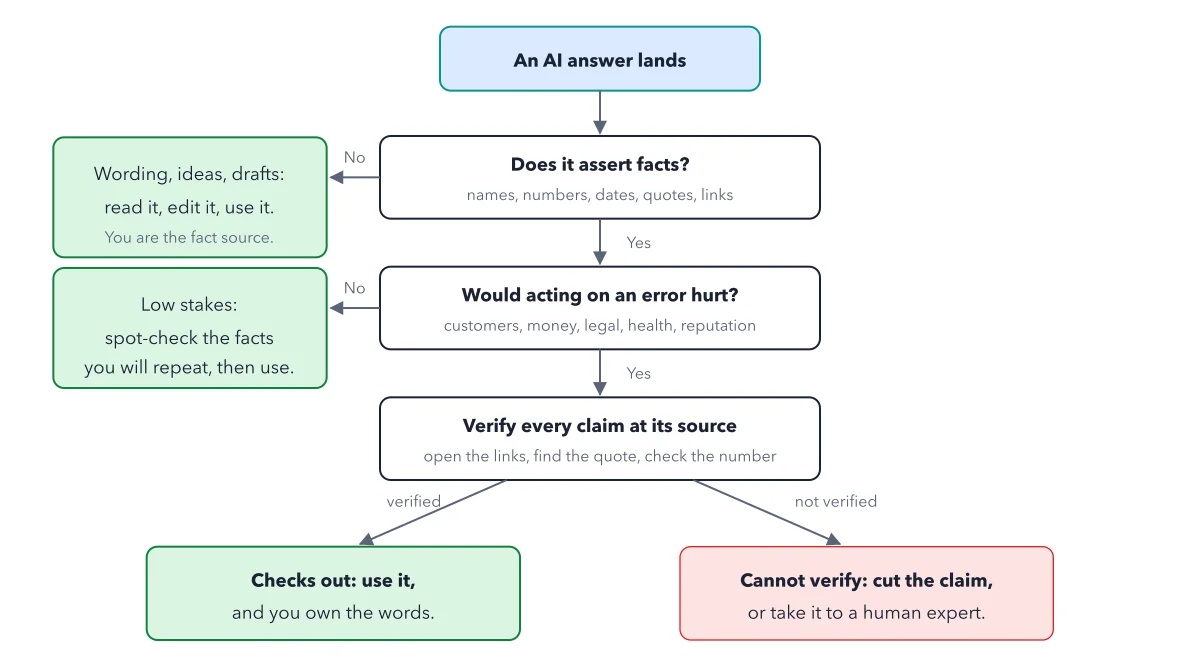
Skip the check and a wrong fact reaches a customer. Check every line and the time AI saved is gone. Learning how to fact check AI answers is about sizing the effort to the cost of an error. The figure below draws it as two questions you can ask in seconds, and three paths they lead to.
Use this diagram on your site
Free to share in your blog post, docs, course or slides, as long as the credit link stays. Paste the code below where the figure should go.
How to read this figure
An AI answer lands. Start at the top with any answer: a draft, a summary, a reply. Before you forward it, you ask two questions, in order.
Question 1: does it assert facts?. Facts are names, numbers, dates, quotes or links: anything someone could check. If no, it is wording, ideas or drafts. Read it, edit it, use it. You are the fact source.
Question 2: would an error hurt?. If it does assert facts, ask whether acting on an error would hurt customers, money, legal, health or reputation. If no, it is low stakes: spot check the facts you will repeat, then use it.
Take the high stakes path. If an error would hurt, verify every claim at its source: open the links, find the quote, check the number. This path is slower on purpose.
Read the two endings. Verified: use it, and you own the words. Not verified: cut the claim, or take it to a human expert, whoever owns that topic.
Key takeaways
- Before you forward an AI answer, ask two questions: does it assert facts, and would an error hurt?
- Ignore the confident tone; check the claim at its source when the stakes are high.
- Name a human owner for each topic, so an unverified claim has somewhere to go.
Worked example: two refund drafts through the flow
At Crystal Goods, the book's example shop, a support rep gets two AI drafts.
- Draft one is a friendly opening line for refund replies. It asserts no facts, so the rep reads it, edits it, and uses it.
- Draft two tells a customer you have 45 days to return this lamp. It asserts a fact, and an error would reach a customer.
- So draft two takes the high stakes path: the rep checks it against the policy page before it goes out.
Result: One draft is used in seconds, the other checked in a minute. If the policy page is unclear, the claim goes to the refund policy owner instead of to the customer.
Questions readers ask
Are people aware of how much AI hallucinates, and how do I spot it?
Errors cluster where the training data ran thin and where an answer needs precision: niche or local facts, exact numbers, citations, links and recent events. Aim your checks there, and open every link before you trust it.
Do I have to check every AI answer?
No. An answer with no facts in it, such as a draft line or a list of ideas, needs no fact check; you are the fact source. Check the facts you will repeat, and every claim when an error would hurt someone.
How do I politely call out AI slop from a colleague?
Point to the flow, not the person. Ask which claims were checked at their source and who owns them. Once verified, the sender owns the words, which is a fair rule for any draft, AI or not.
Sources: Google Cloud: What are AI hallucinations; Anthropic: Reduce hallucinations.
This figure is from AI Made Crystal Clear, chapter 5.
The chapter builds the idea step by step, with recipes you can follow, a Try it to check yourself, and every source.
Get the book