Cursor Made Crystal Clear · chapter 2: The Mental Model: Four Ways to Work
The agent loop
2026-09-15
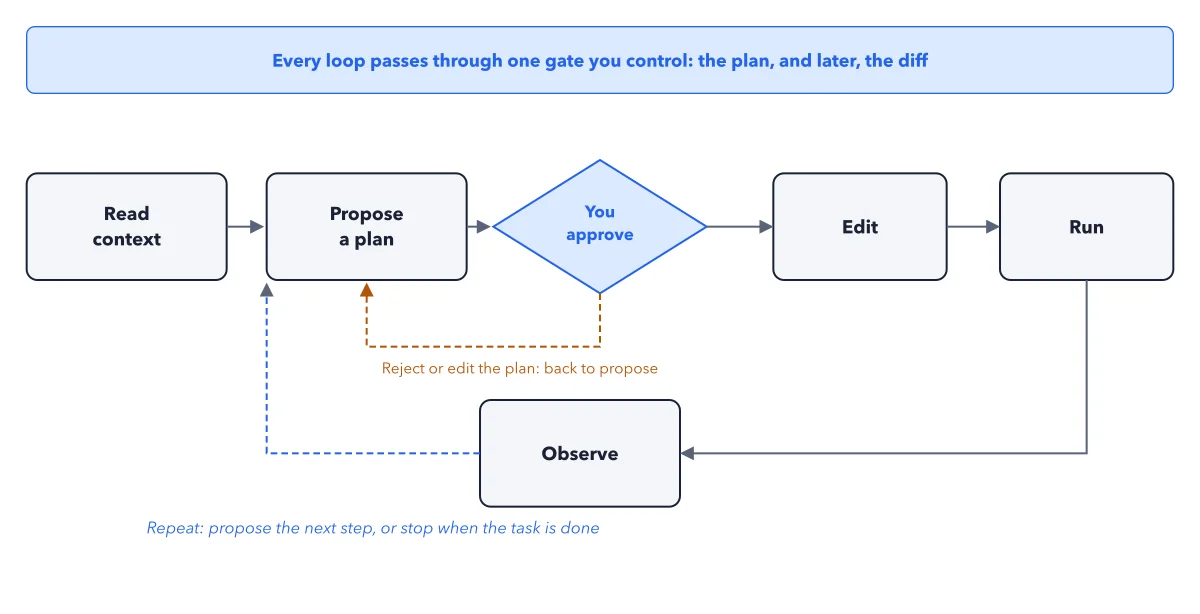
Read, propose, wait for you, edit, run, observe, and repeat, with your approval sitting inside the loop, not after it.
Below: the paragraph from the book that builds this idea, then the diagram itself (Figure 2.1), and a recap. About a minute of reading.
Figure 2.1 previews the shape of that loop: Agent reads context, proposes a plan, waits for you, edits, runs, observes what happened, and repeats until the task looks done. For a genuinely complex or unfamiliar change, you can put a real plan in front of that loop first. Plan Mode "creates detailed implementation plans before writing any code": Agent researches the codebase, asks clarifying questions, and hands you "a reviewable plan you can edit before building," rather than starting to write code on a guess. The documentation is specific about when this extra step is worth it: complex features, changes touching many files, unclear requirements, or architectural decisions, "where you want to review the approach first." For a quick, familiar change, it says plainly that "jumping straight to Agent mode is fine."
Recap
- The idea: Read, propose, wait for you, edit, run, observe, and repeat, with your approval sitting inside the loop, not after it.
- The picture: Figure 2.1, from chapter 2 ("The Mental Model: Four Ways to Work") of Cursor Made Crystal Clear.
- Go deeper: the chapter builds this step by step, with recipes and sources at the end.
This diagram is one of many in Cursor Made Crystal Clear.
Every chapter opens with the gist, draws the hard ideas, and ends with recipes and sources.
Get the book