What one DeepSeek API call can cost, from floor to ceiling
By Christophe Paka · Facts checked on 23 October 2026
You read one price on the DeepSeek pricing page. Then the bill arrives, and it matches nothing you multiplied. One reader asked the same thing about their own bill: "Am I missing something?"
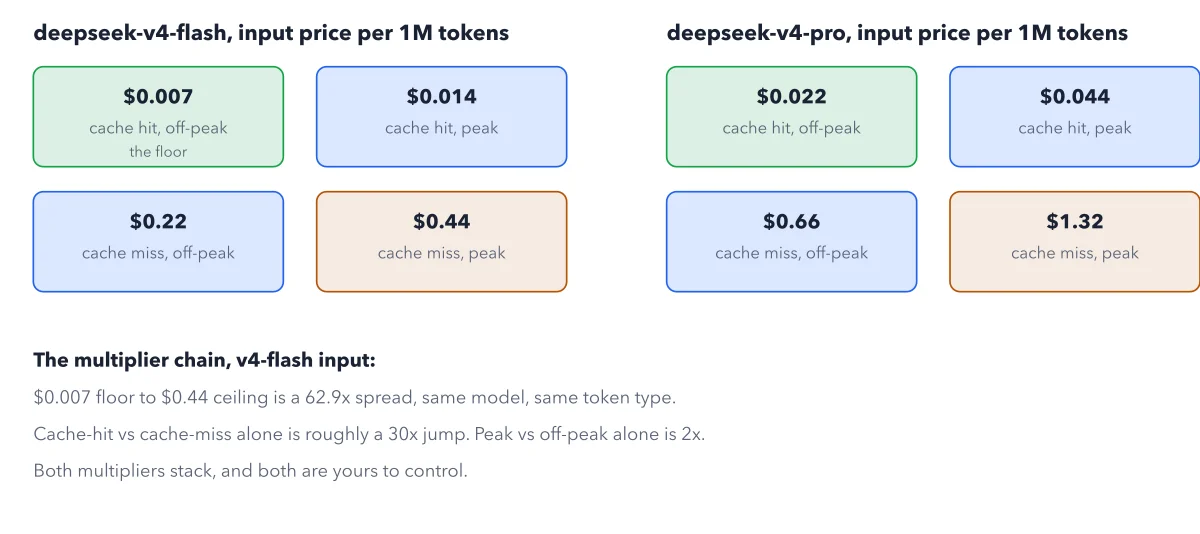
Budget from the wrong number and you can be off by a wide margin, because Flash input alone spans a 100x spread. The DeepSeek API cost of a call depends on which cell of the price grid it lands in. For a small answer bot that takes 9,000 questions, the month runs from about $2.20 to about $16.71, depending on the cells it lands in. The figure below ranks the input cells from floor to ceiling, so you can see where your calls sit and how to move them.
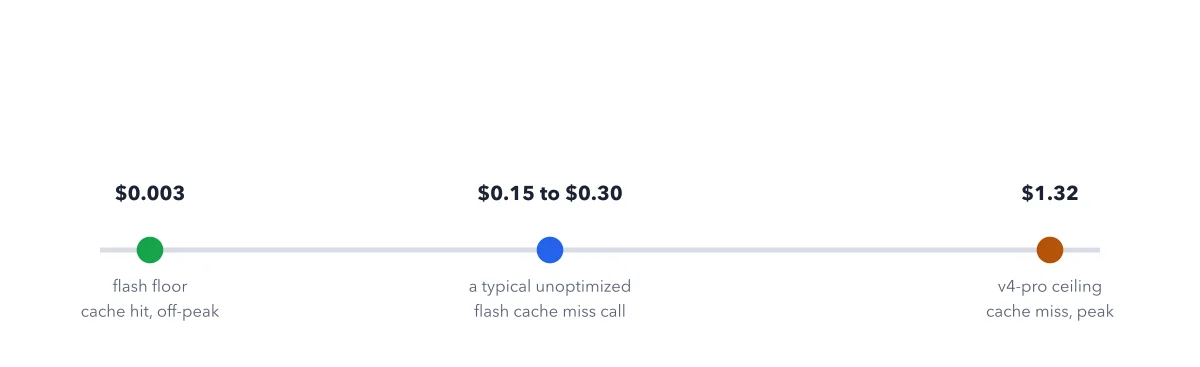
How to read this figure
Read the line from left to right. The line ranks the input price of one call, per 1M tokens, from the cheapest cell to the dearest. The dots show order, not distance, so read the prices above them. In money the gaps are wide: the Flash floor to the typical Flash call is the 100x spread, and the Pro ceiling is more than four times the typical call.
Start at the green floor. The floor is Flash input that is a cache hit, sent off peak. It costs $0.003 per 1M tokens. Only text DeepSeek has seen before, sent outside peak hours, lands here.
Find the typical call in blue. A Flash call with no shared opening is all cache miss. It pays $0.15 to $0.30 per 1M input tokens, off peak or at peak. Most untuned calls land here, far above the floor.
End at the orange Pro ceiling. The ceiling is Pro input that misses the cache at peak. It costs $1.32 per 1M tokens. The price grid shows every cell between, for both models.
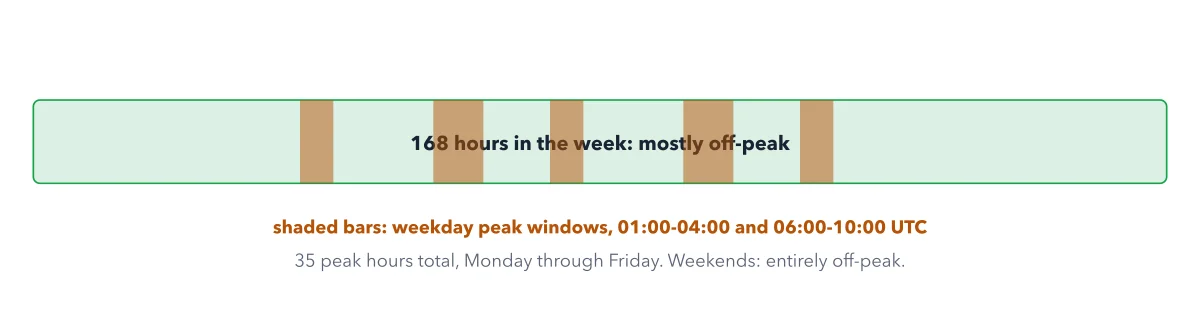
Move your calls to the left. Two moves push a call toward the floor. Put the fixed text first, so most input is a cache hit. Run work that can wait off peak. Output has its own price, $1.20 per 1M tokens on Flash at peak, four times new input. So with a high hit rate, output becomes the biggest line.
Key takeaways
- Price every job by its cell: model, cache hit or miss, peak or off peak.
- Budget from a real usage block and your own hit rate, never from one number on the pricing page.
- Keep a small prepaid balance as your cap, and top up before big batches.
Worked example: one answer bot, four versions of one month
Juniper's answer bot gets 9,000 questions over one month. Each call sends a 6,000 token policy and a 200 token question and gets about 300 tokens back, on Flash with thinking off (the model answers without writing out its reasoning first). Change one thing at a time.
- Policy first, 95% cache hits, all at peak: hits 53.01M x $0.006, misses 2.79M x $0.30, output 2.7M x $1.20, about $4.40 for the month.
- The same month, all off peak: every cell halves, to about $2.20.
- The current time stamped at the top, so only about 40% hit, at peak: about $13.42.
- The policy first month on Pro, at peak, where a hit costs $0.044, a miss $1.32 and output $3.96 per 1M: about $16.71.
Result: The order of the prompt moved the bill more than the clock did. Price your own month with your hit rate and clock split, then add a margin for price changes.
Questions readers ask
Why does my DeepSeek bill not match the price I read?
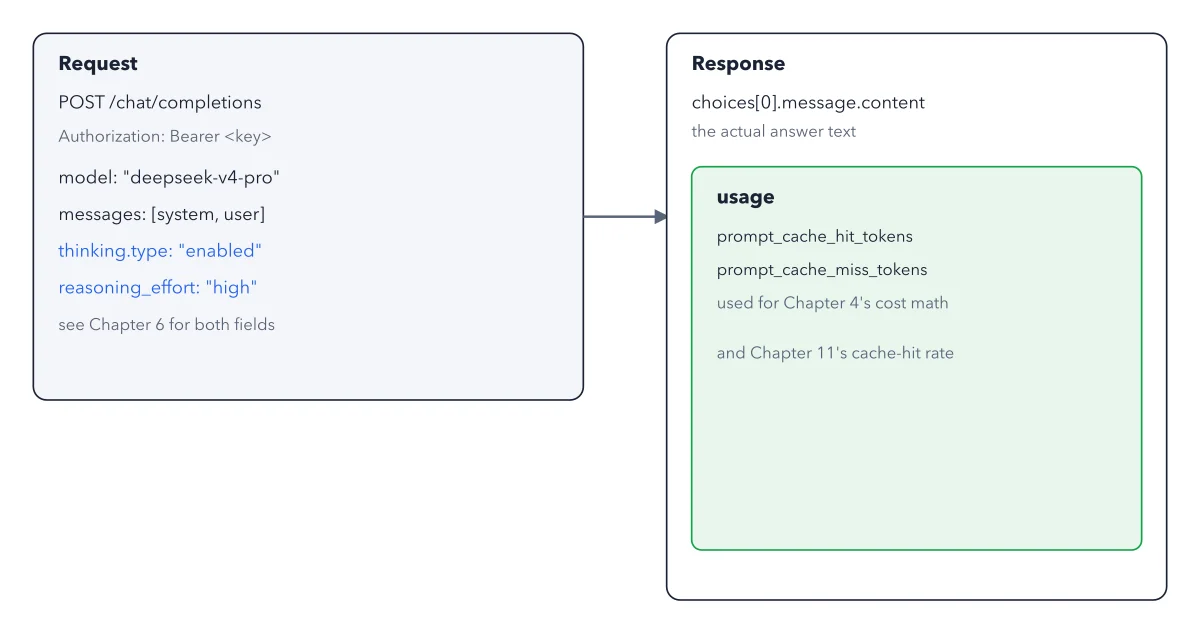
DeepSeek has no single price. Each input token lands in one cell: model, cache hit or miss, peak or off peak. Output has its own price too. Read prompt_cache_hit_tokens and prompt_cache_miss_tokens in the usage block, then price each part by its cell.
How long will my DeepSeek API balance last?
Price one month first, then divide your balance by it. Count calls, read tokens per call from a real usage block, guess the hit rate with care, and split the clock into peak and off peak. A total far above your guess usually means a low hit rate. When the balance reaches zero, calls stop.
Does thinking add to the DeepSeek API cost?
It adds output tokens, and thinking is on by default. DeepSeek bills every input and output token, and its thinking guide does not say how the thinking text is counted. So run the same prompt with thinking on and off, and compare completion_tokens. The difference is what thinking costs you.
Sources: DeepSeek API Docs, Models and Pricing; DeepSeek API Docs, Context Caching.
This figure is from DeepSeek Made Crystal Clear, chapter 4.
The chapter builds the idea step by step, with recipes you can follow, a Try it to check yourself, and every source.
Get the book