Docker Made Crystal Clear · chapter 3: Images, Layers, and Where Containers Come From
Tag anatomy
2026-09-16
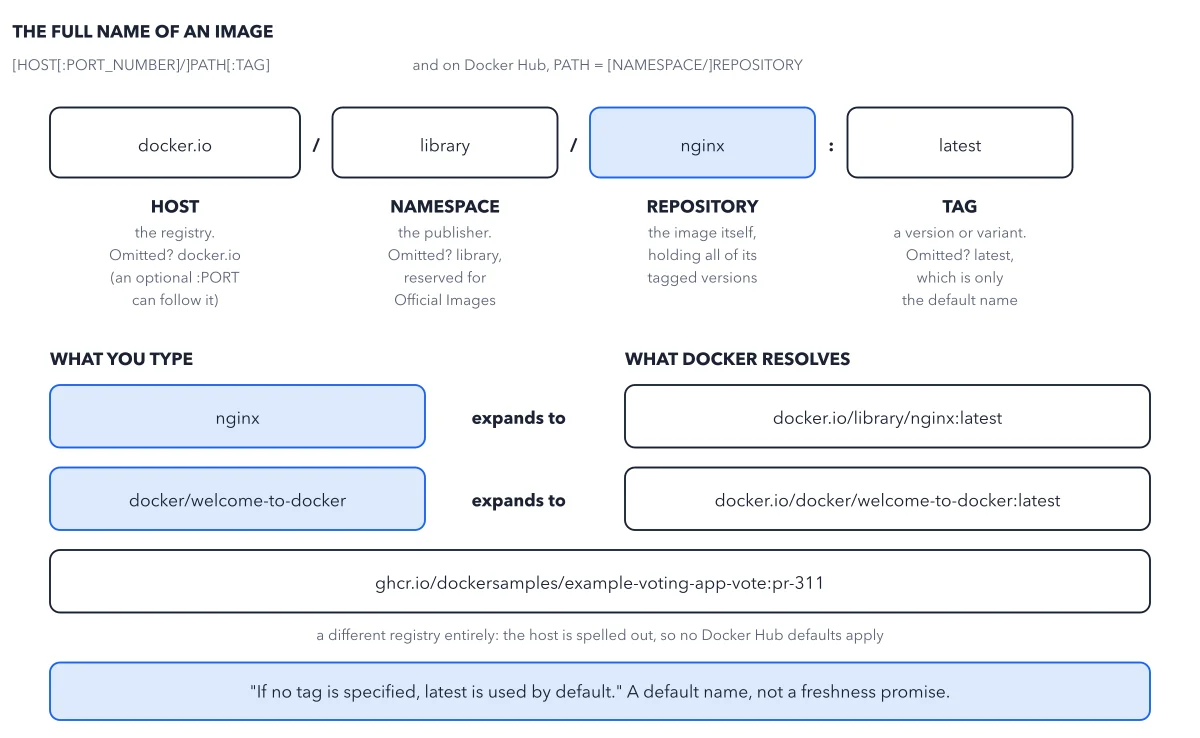
Every image reference is the same four-part address; anything you leave out is filled by a default (docker.io, library, latest). The expansions are the docs' own examples, including a reference on a non-Hub registry where nothing defaults.
Below: the paragraph from the book that builds this idea, then the diagram itself (Figure 3.2), and a recap. About a minute of reading.
Every image you have ever named, nginx, postgres, ubuntu, was shorthand. The full structure of an image name, straight from the docs, is [HOST[:PORT_NUMBER]/]PATH[:TAG]. Four parts, three of which have defaults, which is why the shorthand works. Reading it left to right: HOST is the registry, defaulting to docker.io (Docker Hub) when omitted; an optional PORT_NUMBER can follow the host; PATH is slash-separated, and on Docker Hub takes the form [NAMESPACE/]REPOSITORY, where a missing namespace defaults to library, the space reserved for Official Images; and TAG names a version or variant of the image. Figure 3.2 dissects a familiar name and shows the expansions the docs give.
Recap
- The idea: Every image reference is the same four-part address; anything you leave out is filled by a default (docker.io, library, latest).
- The picture: Figure 3.2, from chapter 3 ("Images, Layers, and Where Containers Come From") of Docker Made Crystal Clear.
- Go deeper: the chapter builds this step by step, with recipes and sources at the end.
This diagram is one of many in Docker Made Crystal Clear.
Every chapter opens with the gist, draws the hard ideas, and ends with recipes and sources.
Get the book