ElevenLabs Made Crystal Clear · chapter 1: Give Your Product a Voice
Where ElevenLabs sits in your stack
2026-08-27
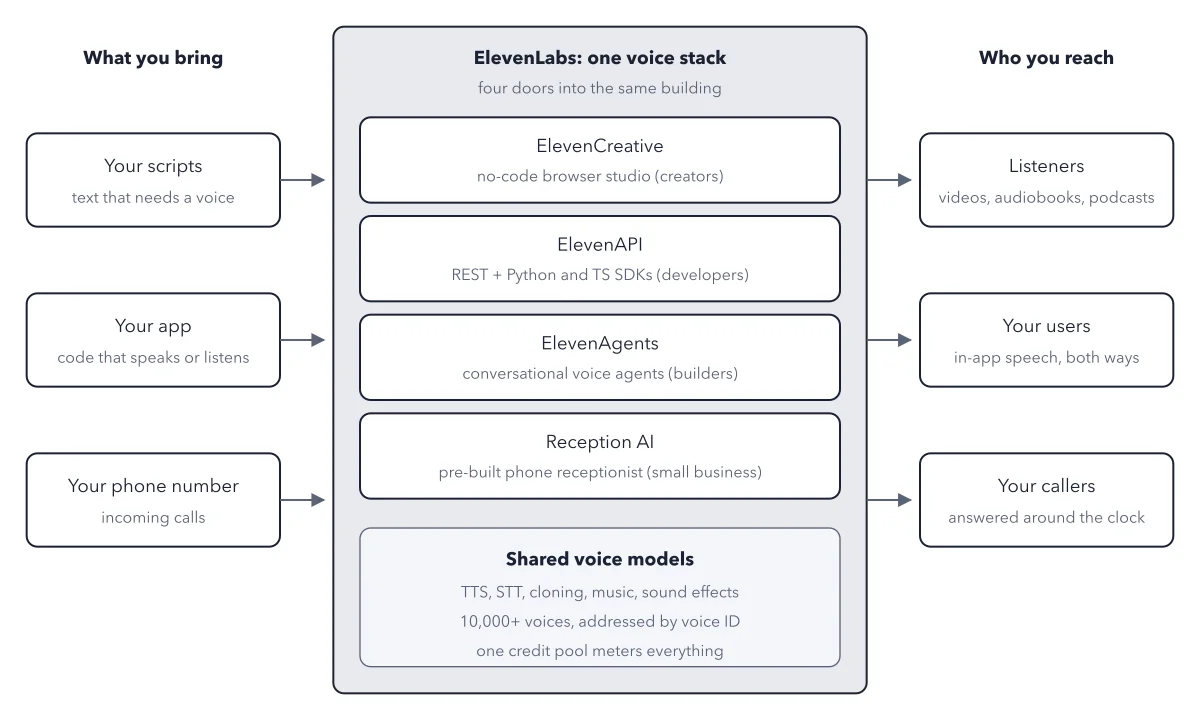
Scripts, app code, and phone calls go in on the left; listeners, users, and callers come out on the right. In between, four product doors open onto the same shared voice models and one credit pool.
Below: the paragraph from the book that builds this idea, then the diagram itself (Figure 1.1), and a recap. About a minute of reading.
Behind all four doors sit the same voice models and the same library of more than 10,000 voices, each addressed by a unique voice ID. And crucially, all four doors draw from one meter: the credit, the platform's shared billing unit. One character of text-to-speech costs one credit; tools that take audio in (transcription, dubbing, cleanup) bill per second or minute of audio instead. Figure 1.1 puts the whole arrangement in one picture: your raw material enters on the left, the stack does the voice work in the middle, and the people you are trying to reach come out on the right.
Recap
- The idea: Scripts, app code, and phone calls go in on the left; listeners, users, and callers come out on the right.
- The picture: Figure 1.1, from chapter 1 ("Give Your Product a Voice") of ElevenLabs Made Crystal Clear.
- Go deeper: the chapter builds this step by step, with recipes and sources at the end.
This diagram is one of many in ElevenLabs Made Crystal Clear.
Every chapter opens with the gist, draws the hard ideas, and ends with recipes and sources.
Get the book