Gemini Made Crystal Clear · chapter 2: Which AI, and Which Gemini
The decision framework
2026-10-10
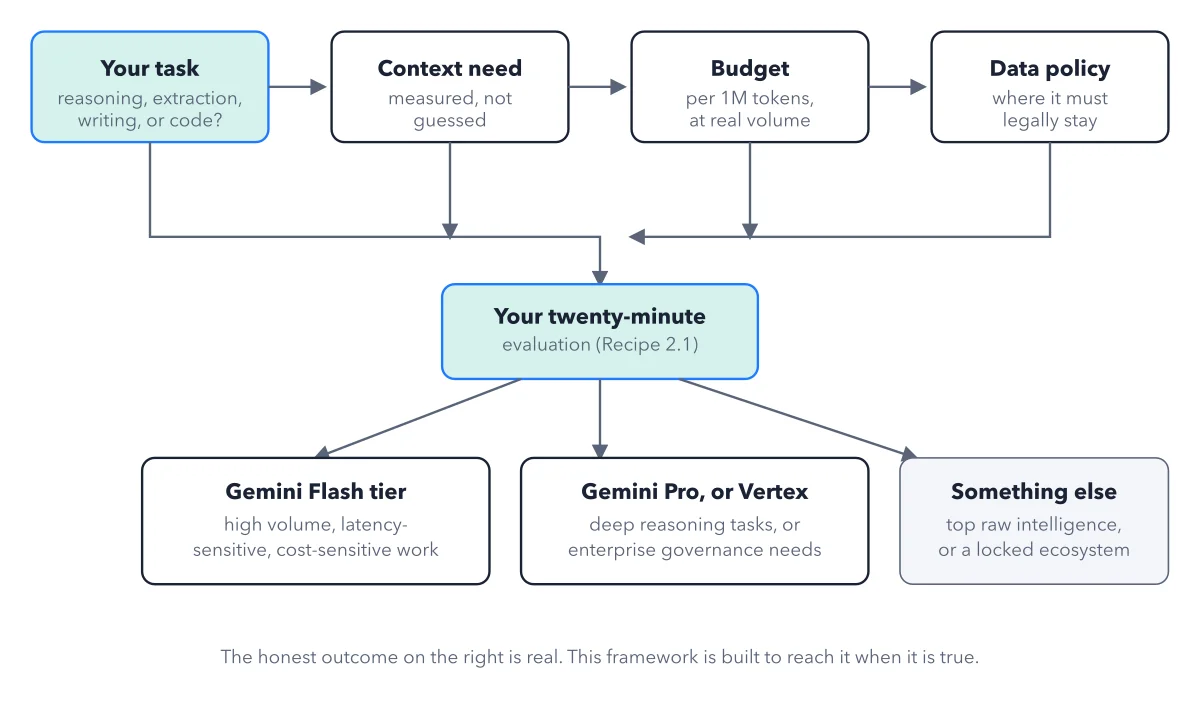
Your task, context need, budget, and data policy feed a twenty-minute evaluation on your own inputs, which points to a recommended surface and model tier, including the honest case where that tier is not Gemini at all.
Below: the paragraph from the book that builds this idea, then the diagram itself (Figure 2.3), and a recap. About a minute of reading.
Put the criteria from earlier in this chapter, the honest leaderboard reading, and your own twenty-minute test together, and the decision stops being a debate about which AI is best in the abstract and becomes a specific, defensible choice for the task in front of you. Figure 2.3 draws that path as a single flow, starting from your task and ending in a recommendation, including the honest outcome that the recommendation is not always Gemini.
Recap
- The idea: Your task, context need, budget, and data policy feed a twenty-minute evaluation on your own inputs, which points to a recommended surface and model tier, including the honest case where that tier is not Gemini at all.
- The picture: Figure 2.3, from chapter 2 ("Which AI, and Which Gemini") of Gemini Made Crystal Clear.
- Go deeper: the chapter builds this step by step, with recipes and sources at the end.
This diagram is one of many in Gemini Made Crystal Clear.
Every chapter opens with the gist, draws the hard ideas, and ends with recipes and sources.
Get the book