
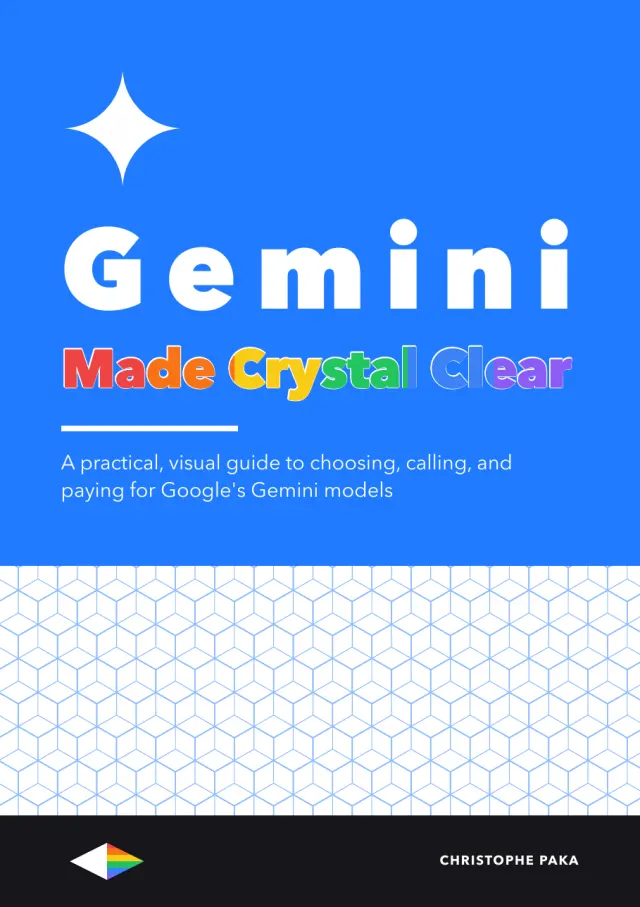
Gemini
Made Crystal Clear
 By Christophe Paka · Updated September 3, 2026
A practical, visual guide to choosing, calling, and paying for Google's Gemini models
Prefer it on your Kindle, or on paper? Same book, on Amazon.
Who this book is for
In plain words: Gemini is Google's family of AI models. This book shows which Gemini product fits you, how to call it from code, and what it costs.
- Developers building on the Gemini API
- Anyone confused about which Google AI product to pick
- Not for: Not for you if you only use the Gemini chat app. Try AI Made Crystal Clear.
Most confusion about Gemini is not about the model, it is about which Gemini you are even looking at. The app, AI Studio, the API, the CLI, Vertex, Workspace: six front doors to overlapping capabilities. This guide opens with a map so you can find yourself on it in five seconds, then teaches the developer path properly: the current Interactions API, structured output you can parse, grounding that shows its sources, and the four levers that cut a token bill. It is honest about where Gemini leads on price and speed and where it does not lead at all, and it names every number Google declines to publish instead of inventing one.
- Pages
- 163
- Level
- Beginner to advanced
- Updated
- September 3, 2026
12 real pages. Click a page to enlarge it.
Inside the book
- 01The Gemini Family Map
- 02Which AI, and Which Gemini
- 03The Gemini App in Practice
- 04Gemini in Google Workspace
- 05AI Studio and Your First API Call
- 06The Model Lineup
- 07The Interactions API
- 08Structured Output and Function Calling
- 09Tools and Grounding
- 10Multimodal and Long Context
- 11Generating Images, Speech, and Video
- 12The Money Chapter
- 13Limits, Safety, and Troubleshooting
- 14Privacy, Data, and the Enterprise Path
- 15The Playbook, Cheat Sheet, and Where to Go Next
You'll leave with
- Place yourself on the map of six Gemini surfaces in seconds
- Choose a model with stated criteria instead of leaderboard vibes
- Write against the current Interactions API, not a stale tutorial
About the author
Christophe Paka writes every book on the shelf. He spent years in technical support at Salesforce and Microsoft, where the job was to make complex systems clear to customers who needed them working the same day. He has since built and run software as a founder and lead developer, worked as a Salesforce consultant, and grown a YouTube channel on tech careers past one million views.
This book was last updated on September 3, 2026.
Connect on LinkedIn →For teams
Put Gemini on every desk at your company.
One licence, every book in the series, one link for everyone. From $250 a year.
Sources
Every source cited in Gemini Made Crystal Clear. Each number matches the [n] marker next to that link in the book's "Go deeper" lists, so you can trace any claim back to its origin.
- [1]Gemini API docs
- [2]Google AI Studio
- [3]Vertex AI generative AI overview
- [4]Gemini CLI on GitHub
- [5]Google Antigravity
- [6]Gemma
- [7]Arena Text Arena leaderboard
- [8]Artificial Analysis model leaderboards
Show all 60 sources
- [9]Artificial Analysis: Gemini 3 Flash, everything you need to know
- [10]Simon Willison: trying out Gemini 3.1 Pro
- [11]Wayfair tech blog: Gemini, Windsurf, and Cursor for modern development
- [12]Gemini models reference
- [13]Google AI plans
- [14]Gemini subscriptions
- [15]Deep Research overview
- [16]Canvas overview
- [17]Gems overview
- [18]Scheduled actions announcement
- [19]Google Workspace pricing
- [20]Gemini in Docs, Sheets, Slides, Vids, Forms, and Drive
- [21]Gemini Workspace updates, March 2026
- [22]Gemini Apps Privacy Hub
- [23]Manage access to Gemini features in Workspace services
- [24]Gemini API quickstart
- [25]Official SDKs and libraries
- [26]Gemini API pricing
- [27]Gemini Code Assist deprecation reference
- [28]gemini-3.8-flash model card
- [29]What's new in Gemini 3.5
- [30]Gemini API changelog
- [31]Google's original Gemini announcement
- [32]Interactions API overview
- [33]Migration guide, generateContent to Interactions
- [34]Gemini thinking (reasoning)
- [35]Interactions API breaking changes, May 2026
- [36]Structured output
- [37]Function calling
- [38]Grounding with Google Search
- [39]URL context
- [40]Google Maps grounding
- [41]File Search
- [42]Code execution
- [43]AA-Omniscience live board
- [44]Long context
- [45]Document understanding and the Files API
- [46]Image understanding
- [47]Audio understanding
- [48]Video understanding
- [49]Goodbye Vector Databases? Gemini long context and caching cost analysis
- [50]Gemini API: image generation
- [51]Gemini API: speech generation
- [52]Gemini API: Live API overview
- [53]Gemini API: Live API capabilities
- [54]Gemini API: Live API sessions
- [55]Gemini API: context caching
- [56]Gemini API: Batch API
- [57]Gemini API rate limits
- [58]Gemini API safety settings
- [59]Data governance for Gemini for Google Cloud
- [60]Aider's leaderboard
Also in the series
37 more titles, one tool or topic each. Swipe or use the arrows.

AI Go To Market
Available
Higgsfield
Available
Kubernetes
Available
Cloudflare
Available
Jev
Available
Supabase
Available
AI Video
Available
Zernio
Available
Make.com
Available
Codex
Available
Hugging Face
Available
Modal
Available
Lovable
Available
Vapi
Available
n8n
Available
AI Agents
Available
Tech Hiring
Available
ElevenLabs
Available
AI
Available
Claude Code
Available
Git
Available
Kimi Code
Available
Hermes Agent
Available
GitHub
Available
Docker
Available
Qwen
Available
Llama
Available
DeepSeek
Available
OpenRouter
Available
GLM
Available
Mistral
Available
OpenClaw
Available
Grok Bot
Available
Vercel
Available
Fly.io
Available
Cursor
Available
The +1 Method
AvailableNew books, in your inbox
One short note when a new Made Crystal Clear guide ships.
No spam, unsubscribe anytime.