Git Made Crystal Clear · chapter 2: What Git Is, and Why It Won
Centralized vs distributed
2026-08-30
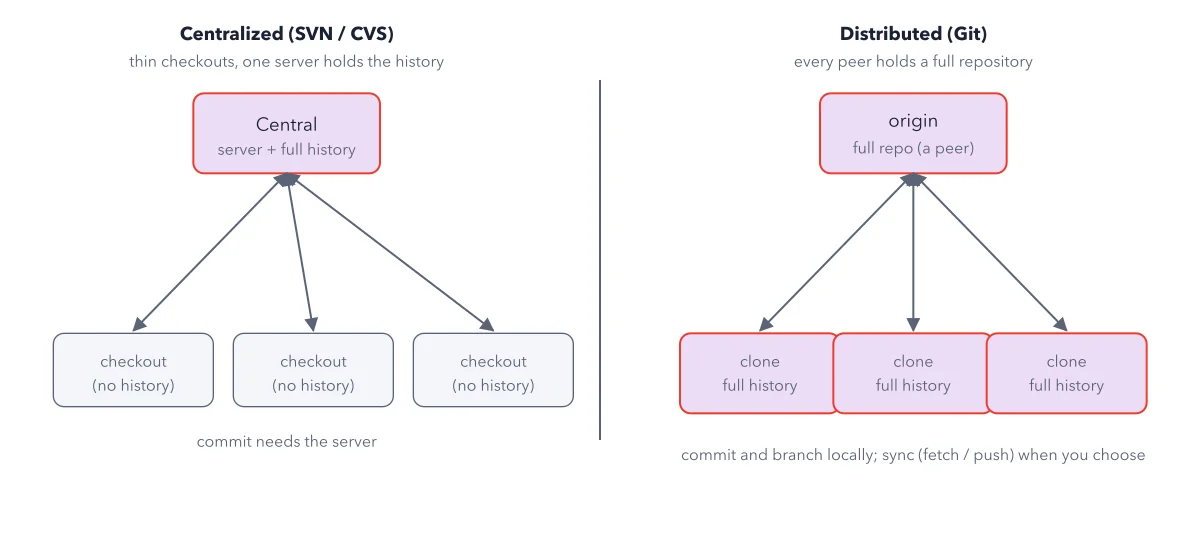
A central server hands out thin checkouts and mediates every commit; in Git each clone is a complete repository, so work happens locally and syncing is a separate, explicit step.
Below: the paragraph from the book that builds this idea, then the diagram itself (Figure 2.2), and a recap. About a minute of reading.
Older centralized systems keep the one true repository on a server. Your working copy is a thin checkout, and to commit, branch, or read history you generally need the server. In Git, every peer holds a full repository. You commit locally, branch locally, and read the entire history locally; syncing with others is a separate, explicit step.
Recap
- The idea: A central server hands out thin checkouts and mediates every commit; in Git each clone is a complete repository, so work happens locally and syncing is a separate, explicit step.
- The picture: Figure 2.2, from chapter 2 ("What Git Is, and Why It Won") of Git Made Crystal Clear.
- Go deeper: the chapter builds this step by step, with recipes and sources at the end.
This diagram is one of many in Git Made Crystal Clear.
Every chapter opens with the gist, draws the hard ideas, and ends with recipes and sources.
Get the book