Hugging Face Made Crystal Clear · chapter 2: The Big Picture: Hub, Libraries, and Two Ways to Run
The master schema of Hugging Face
2026-09-05
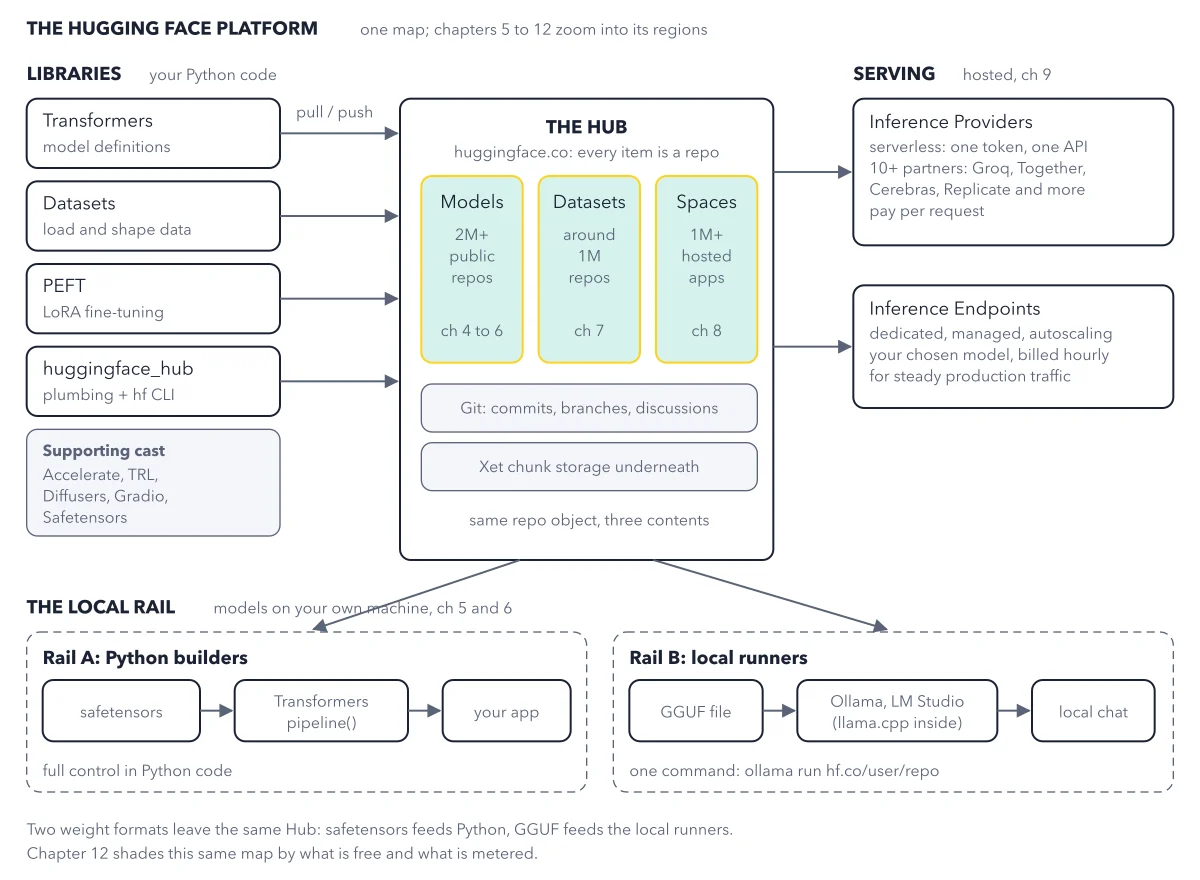
The Hub holds Models, Datasets, and Spaces as Git repos on Xet storage; the library ring works with it from Python; the serving side and the local rail are the two ways to run what you find. Counts are dated mid 2026 and keep growing.
Below: the paragraph from the book that builds this idea, then the diagram itself (Figure 2.1), and a recap. About a minute of reading.
Now the map this book keeps coming back to. Figure 2.1 is the master schema: the Hub in the center, the libraries on the left, hosted serving on the right, and the local rail along the bottom. Chapters 5 and 6 zoom into the local rail, chapter 7 into the Datasets column, chapter 8 into Spaces, chapter 9 into the serving side, and chapter 12 shades the same map by what is free and what is metered. If you memorize one figure from this book, make it this one.
Recap
- The idea: The Hub holds Models, Datasets, and Spaces as Git repos on Xet storage; the library ring works with it from Python; the serving side and the local rail are the two ways to run what you find.
- The picture: Figure 2.1, from chapter 2 ("The Big Picture: Hub, Libraries, and Two Ways to Run") of Hugging Face Made Crystal Clear.
- Go deeper: the chapter builds this step by step, with recipes and sources at the end.
This diagram is one of many in Hugging Face Made Crystal Clear.
Every chapter opens with the gist, draws the hard ideas, and ends with recipes and sources.
Get the book