Hugging Face Made Crystal Clear · chapter 2: The Big Picture: Hub, Libraries, and Two Ways to Run
Transformers as the ecosystem pivot
2026-10-08
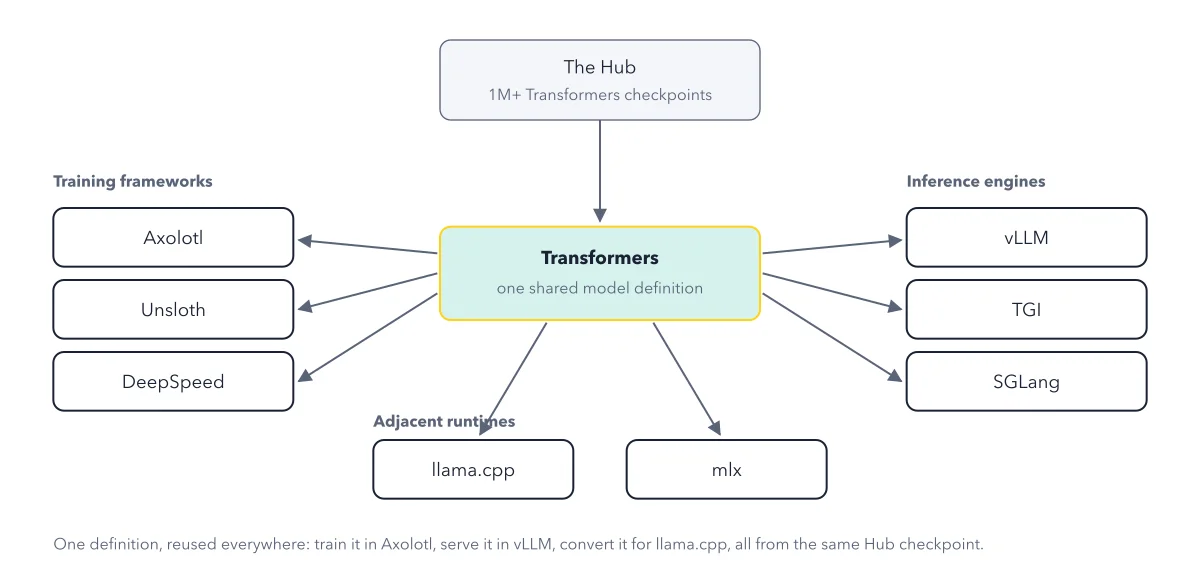
Training frameworks, inference engines, and adjacent runtimes all build on the same model definitions, which is why a model published once runs in so many places.
Below: the paragraph from the book that builds this idea, then the diagram itself (Figure 2.3), and a recap. About a minute of reading.
One of these libraries matters beyond Hugging Face itself. The Transformers docs describe it as "the model-definition framework for state-of-the-art machine learning models," and the key word is definition. A model definition is the exact recipe for a model's architecture. Because most of the open ecosystem reuses Transformers' definitions instead of writing their own, one checkpoint on the Hub can move between tools without translation. Figure 2.3 shows that pivot role.
Recap
- The idea: Training frameworks, inference engines, and adjacent runtimes all build on the same model definitions, which is why a model published once runs in so many places.
- The picture: Figure 2.3, from chapter 2 ("The Big Picture: Hub, Libraries, and Two Ways to Run") of Hugging Face Made Crystal Clear.
- Go deeper: the chapter builds this step by step, with recipes and sources at the end.
This diagram is one of many in Hugging Face Made Crystal Clear.
Every chapter opens with the gist, draws the hard ideas, and ends with recipes and sources.
Get the book