Jev Made Crystal Clear · chapter 2: How Jev Works: State In, Typed Answers Out
The big schema
2026-10-03
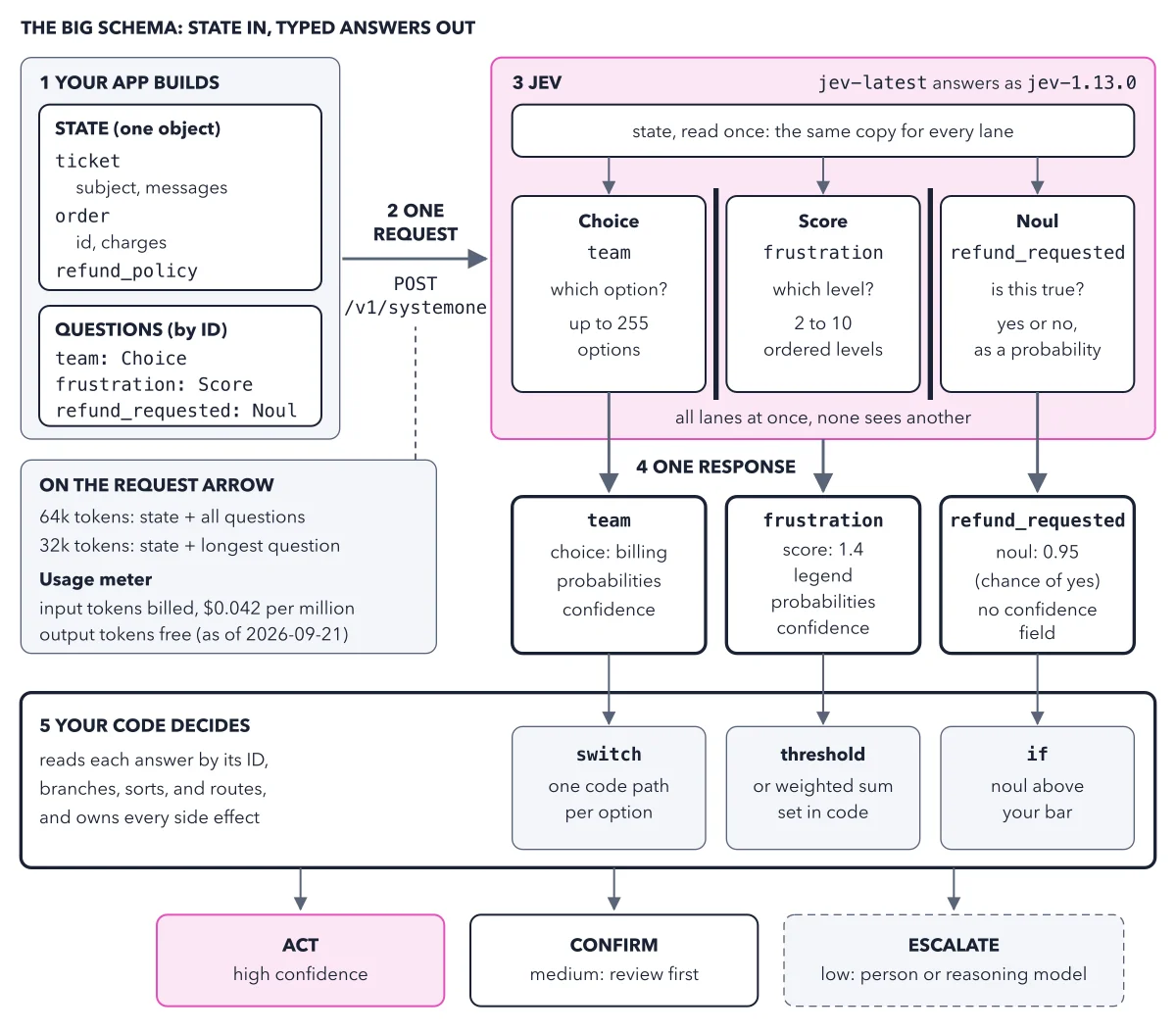
(1) Your app builds one state and a map of questions keyed by IDs your code chooses. (2) One request carries both, under the 64k and 32k context budgets, with a usage meter that bills input tokens only. (3) Jev reads the state once and judges each question in its own walled-off lane, in parallel. (4) One response returns a typed answer per ID. (5) Your code maps each answer onto a switch, a threshold, or an if, and acts, confirms, or escalates. Answer values are the docs' illustrative ones from the System One page; price as of 2026-09-21. Every later architecture figure zooms into one region of this one.
Below: the paragraph from the book that builds this idea, then the diagram itself (Figure 2.1), and a recap. About a minute of reading.
Figure 2.1 is the master diagram of this book. Read it in five numbered steps. Your app builds a state (here, one object holding a support ticket, an order, and a refund policy) and a questions map (a Choice, a Score, and a Noul, each under an ID you pick). One request carries both to Jev, with the two context budgets and a usage meter riding on it. Inside Jev, the state is read once and every question gets its own walled-off lane. One response comes back with a typed answer per question. Your code turns each answer into an action: act, confirm, or escalate.
Recap
- The idea: (1) Your app builds one state and a map of questions keyed by IDs your code chooses.
- The picture: Figure 2.1, from chapter 2 ("How Jev Works: State In, Typed Answers Out") of Jev Made Crystal Clear.
- Go deeper: the chapter builds this step by step, with recipes and sources at the end.
This diagram is one of many in Jev Made Crystal Clear.
Every chapter opens with the gist, draws the hard ideas, and ends with recipes and sources.
Get the book