Kimi Code Made Crystal Clear · chapter 1: What Kimi Code Is, and the Question Everyone Asks
The Kimi Code stack
2026-08-27
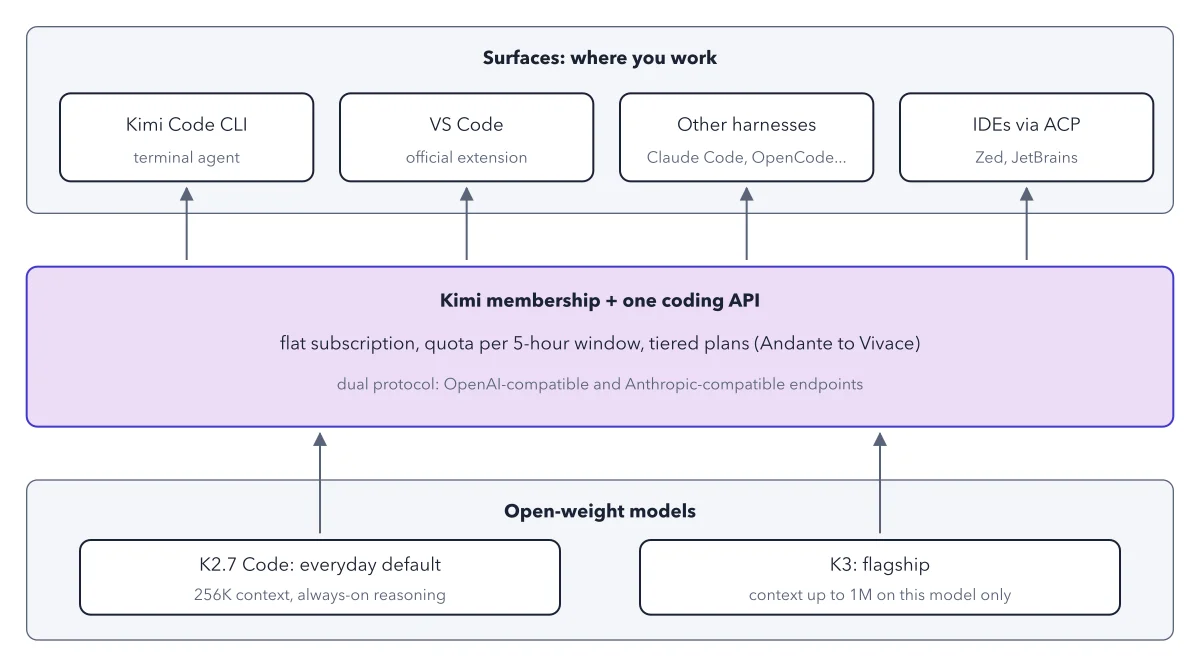
Open-weight models at the bottom, one membership and dual-protocol API in the middle, and many surfaces on top. You pick the surface; the subscription and models stay the same.
Below: the paragraph from the book that builds this idea, then the diagram itself (Figure 1.1), and a recap. About a minute of reading.
The second structural choice is openness at both ends of the stack. At the bottom, the models themselves (the K2 and K3 families) are released as downloadable open weights on Hugging Face, and the CLI itself is MIT-licensed code on GitHub. At the top, the service exposes one coding API that speaks two wire protocols, OpenAI-compatible and Anthropic-compatible. That dual-protocol design is why the same membership works not only in Moonshot's own Kimi Code CLI and VS Code extension, but also inside third-party harnesses (a harness is the agent program that drives the model: its tools, prompts, and loop). The docs list Claude Code, OpenCode, Codex, and Hermes Agent as supported harnesses, plus Zed and JetBrains IDEs. Figure 1.1 puts the three layers in one picture.
Recap
- The idea: Open-weight models at the bottom, one membership and dual-protocol API in the middle, and many surfaces on top.
- The picture: Figure 1.1, from chapter 1 ("What Kimi Code Is, and the Question Everyone Asks") of Kimi Code Made Crystal Clear.
- Go deeper: the chapter builds this step by step, with recipes and sources at the end.
This diagram is one of many in Kimi Code Made Crystal Clear.
Every chapter opens with the gist, draws the hard ideas, and ends with recipes and sources.
Get the book