Hiring without a recruiter: four tools against one fee
By Christophe Paka · Facts checked on 30 October 2026
Your search for a first engineer has stalled, and an agency offers to take it over. A reader on Reddit asked what a typical agency charges, and guessed a share of the annual salary. For a senior engineer, that share is a large check for one hire.
Pay it each time you hire, and the process still lives in someone else's head.
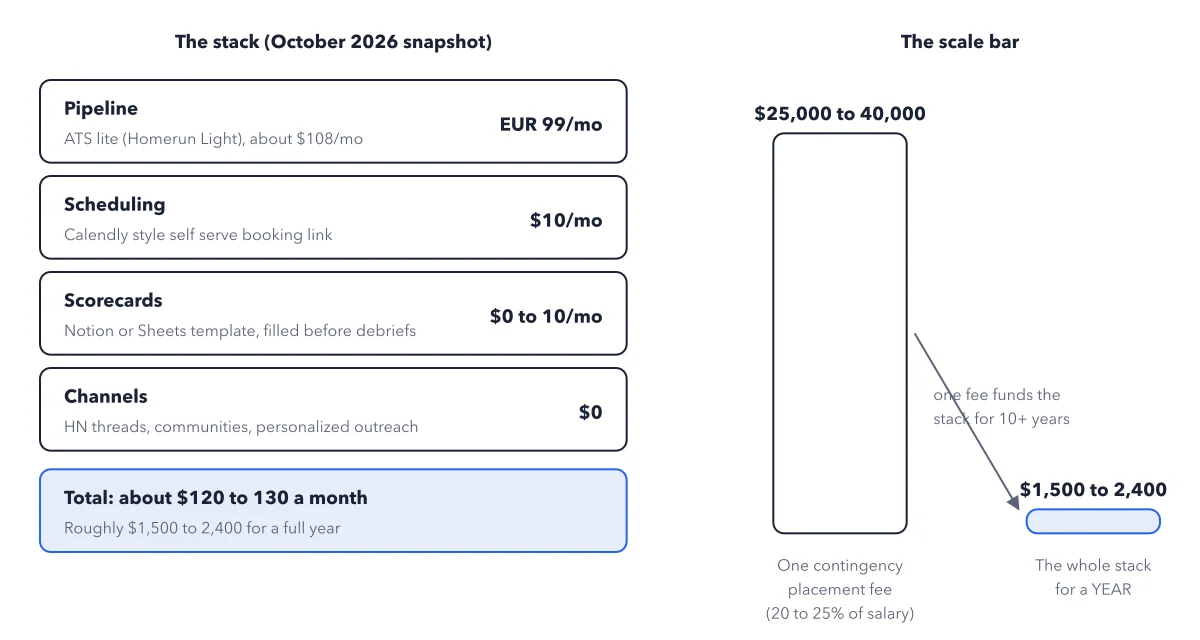
Hiring without a recruiter needs four tools, not a team. The figure prices them and sets their yearly cost beside one recruiter fee.
How to read this figure
Start with the pipeline. The pipeline is an ATS (applicant tracking system): software that collects applications and tracks each candidate, so nobody gets lost. It is the only real cost in the stack. The figure labels it "ATS lite" and prices one example, Homerun's entry plan, called Light, at EUR 99 a month, about $108. Any ATS with tracking and a careers page does the job.
Add a booking link. A scheduling link lets candidates pick their own slot, so there is no email back and forth. Ashby finds that booked interviews confirm 26% faster than ones scheduled by hand. The figure prices a Calendly style link at $10 a month.
Keep scorecards in a template. Scorecards live in a Notion or Google Sheets template, for little or no cash. Each interviewer fills one in before the debrief, so every score has evidence behind it. You build it once and copy it per candidate.
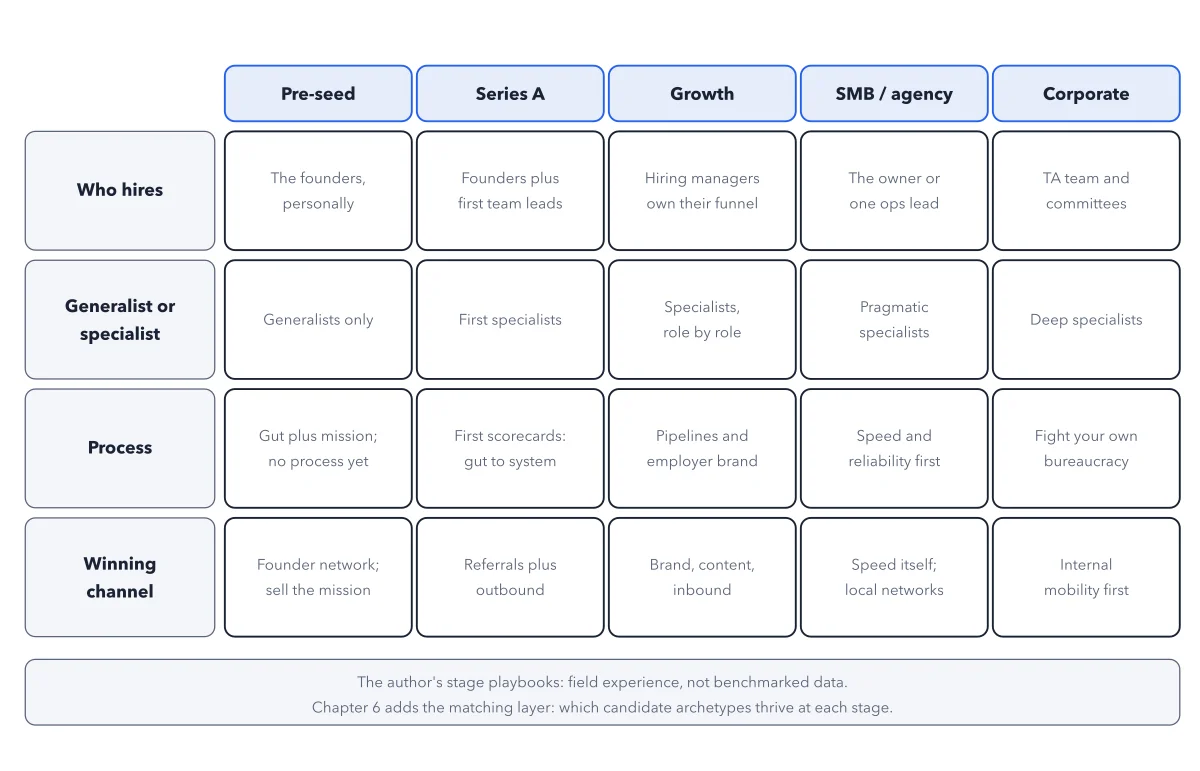
Use the free channels. Hacker News (HN on the figure, a tech news forum) threads, communities and your own personal messages cost attention, not cash. They are the channels a small company can work better than a big one. The channel map shows where each one sits.
Add up the column. The total box reads about $120 to $130 a month. Twelve months at $120 to $130 is about $1,500 a year. The figure's upper end, $2,400, adds a paid email sequencing tool, which sends a planned series of follow up emails for you; it has no box of its own.
Read the scale bar. A contingency fee is a recruiter's fee paid only when they place someone. The tall bar is one such fee, at 20 to 25% of salary: $25,000 to $40,000 for a senior engineer. The small bar is a whole year of the stack.
Key takeaways
- Under about five open candidates at a time, use a shared spreadsheet; past that, an ATS pays for itself.
- Before you pick an ATS, check that you can export candidates and notes, so leaving later costs an afternoon.
- If you do use an agency, write the identity checks into the brief: a contingency fee rewards closing fast, not checking.
Worked example: how many years one fee buys
Take one senior engineer and the most quoted contingency rate. Then compare the fee with a year of the stack.
- The salary is $140,000 and the fee is 20%.
- The fee for this one hire is $28,000.
- The stack costs $1,500 to $2,400 a year.
- Divide the fee by the yearly cost: $28,000 buys just under 12 years of a $2,400 stack, and just under 19 years of a $1,500 one.
Result: Either way, one placement fee pays for the stack for more than ten years. The stack copies only the mechanical part of a recruiter's job. It cannot copy judgment and closing, so spend your own hours there.
Questions readers ask
How much does a recruitment agency charge?
Pin, which sells sourcing software, puts the contingency fee at 15 to 25% of first year salary, and 20% is the most quoted rate. For a senior engineer on a $125,000 to $160,000 salary, plan on 20 to 25%: $25,000 to $40,000 for one hire.
Do I need an ATS at all?
The book's rule of thumb: under about five open candidates at a time, a shared spreadsheet with one row per person works. Past that, people wait unnoticed, and an ATS pays for itself.
Is a recruitment agency worth it?
Yes, when your calendar cannot absorb a full hiring loop this quarter. But a contingency fee rewards closing fast, not checking who is real. So write the identity checks into the agency's brief, or nobody may run them.
As a candidate, will a company with no recruiter leave me waiting?
It should not, if it runs this stack. The book's setup sends a receipt that promises an answer within five business days, blocks a weekly pipeline check so no one waits past that promise, and sends a respectful no, from a person, to anyone the company spoke with.
Sources: Homerun pricing; Calendly pricing; Pin: recruitment agency commission structures.
This figure is from Tech Hiring Made Crystal Clear, chapter 6.
The chapter builds the idea step by step, with recipes you can follow, a Try it to check yourself, and every source.
Get the book