The types of software engineers, drawn as the floors of one product
By Christophe Paka · Facts checked on 30 October 2026
You post a job for "a developer". The applications pour in. Many build screens, a few run servers, and one says they do it all. You still do not know who can fix the slow database that started the search.
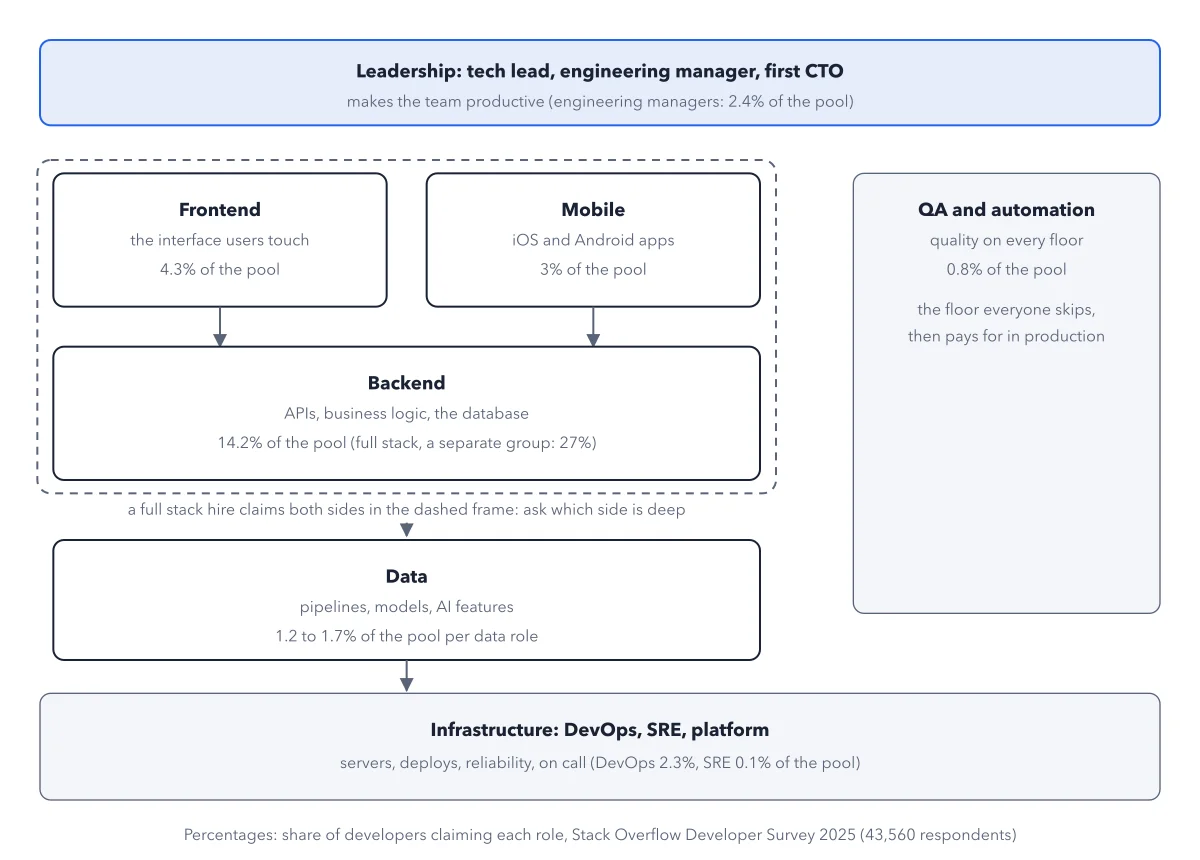
That is the cost of a vague title: the post draws the wrong crowd, and the hire is great at half the job. This post shows the types of software engineers as floors of one product. Find the floor where your problem lives, and the role names itself.
Use this diagram on your site
Free to share in your blog post, docs, course or slides, as long as the credit link stays. Paste the code below where the figure should go.
How to read this figure
Start at the top: leadership. Tech leads, engineering managers and a first CTO make the team productive. They are a small slice of the pool, about 2.4%. You rarely need one before you have a team to lead; promote or hire for the first lead covers that choice.
Read the dashed frame. Frontend builds the screens users touch, 4.3% of the pool. Mobile builds the iOS and Android apps, 3%. Backend builds the server side: the APIs, the business rules and the database. The dashed frame around these three is what a full stack hire claims, but most are deep on one side only.
Compare the pool sizes. The pool is everyone you could hire. Each percentage is the share of the 43,560 developers in Stack Overflow's survey who named that role as theirs. Each person counts once, so full stack (27%) is its own group, written in brackets under Backend (14.2%), not a box. The map shows only roles that own a floor, so the shares do not add up to 100%.
Look at the thin floors. Data roles sit at 1.7% or less each. At the base, infrastructure keeps the product running: servers, deploys, reliability and on call. DevOps is 2.3% of the pool and SRE is 0.1%. For these floors, few people will apply to a post, so you go and find them yourself, or you train someone you already have.
Do not skip the side column. QA, or quality assurance, owns testing on every floor. It is 0.8% of the pool. The figure calls it the floor everyone skips, then pays for in production, when the bugs reach customers.
Key takeaways
- Name the floor your problem lives on before you name the role or write the post.
- In every full stack post, write which side is deep, and ask the candidate the same thing.
- For a thin floor such as SRE, plan to reach out to people, not to wait for applicants.
Worked example: naming the role for a slow database
Tidewell is the book's made up 12 person company. Its queries are slow and fail under load. Here is how the map turns that problem into a role.
- Find the floor. Queries and the database sit on the backend floor, not on the screens.
- Name the role. The backend engineer owns that floor, so the post asks for one, not for "a developer".
- Name the deep skill. Tidewell writes the language and the database it uses into the title.
- Write the hard parts down. The post says the hire is on call one week in four.
- Read the pool. Backend is a wide pool, so the hard part is checking who is real, not finding people.
Result: Tidewell posts for a senior backend engineer with one deep skill and a true on call line. The post draws backend people, and the screen asks about scale and speed numbers.
Questions readers ask
What is the difference between frontend, backend and full stack?
Frontend builds the screens users see and touch. Backend builds the server side: APIs, business rules and the database. Full stack claims both, but nearly every real one is deep on one side and broad on the rest. Each side takes two to three years to master, so ask which side they would build alone.
How do I hire a developer when I am not technical?
Start with the map, not the title. Write down the problem, find its floor, and name the role that owns it. Then ask a technical advisor to run the deep questions, such as which side of the stack a full stack candidate knows best.
Is "equally strong on both sides" a good sign in a full stack candidate?
No. The book treats it as a red flag. Strong full stack engineers name their deep side without being asked. A hire who is deep on the wrong side leaves the floor your problem lives on still unowned.
As a developer, which pools are crowded and which are thin?
Full stack (27%) and backend (14.2%) are the wide pools. There, employers get volume, and their problem is checking who is real. Data roles, DevOps and SRE are thin slices: almost nobody applies, so employers reach out to people themselves or train someone they already have.
Sources: Stack Overflow Developer Survey: developer roles; Google SRE Book, chapter 1.
This figure is from Tech Hiring Made Crystal Clear, chapter 4.
The chapter builds the idea step by step, with recipes you can follow, a Try it to check yourself, and every source.
Get the book