AI Agents Made Crystal Clear · chapter 2: What an Agent Actually Is
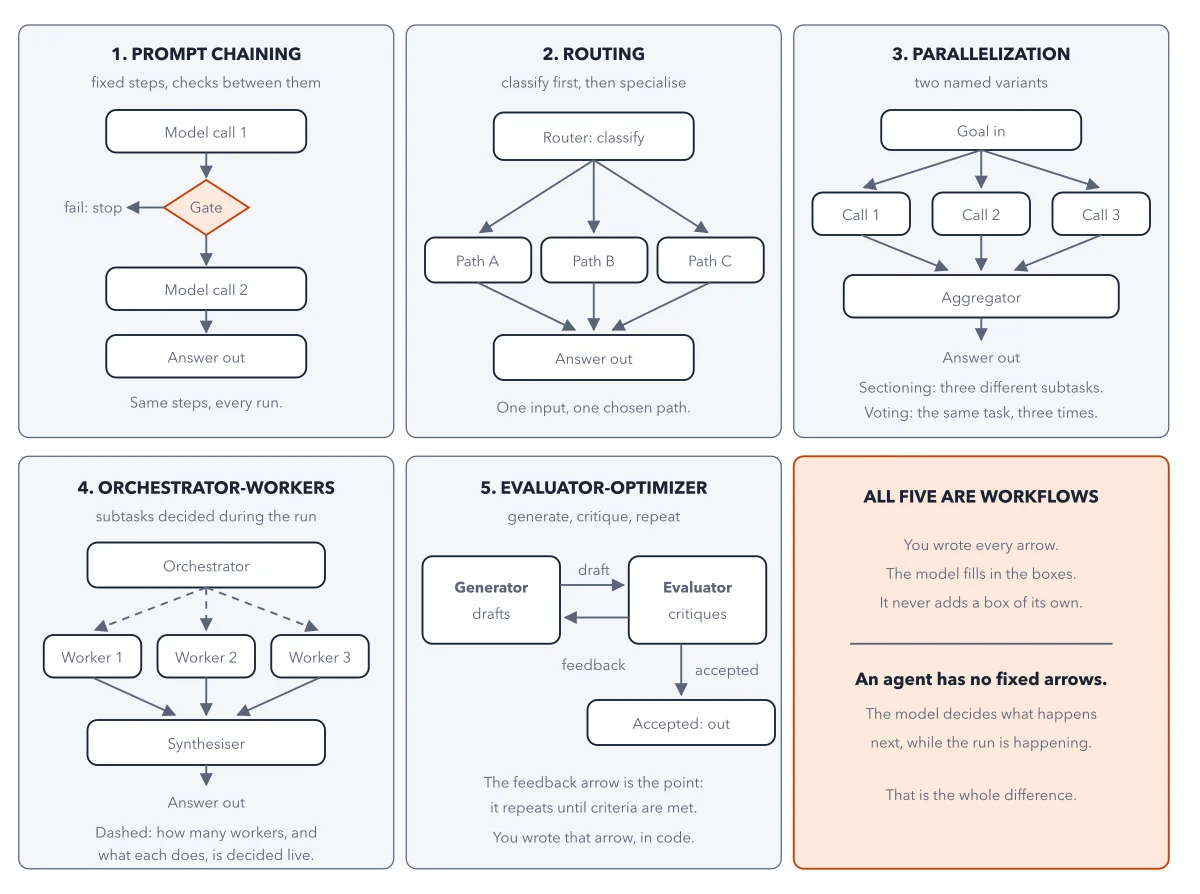
The five workflow patterns from Anthropic's "Building effective agents", at one scale
2026-09-10
Solid arrows are paths a developer wrote. The dashed arrows in orchestrator-workers mark the one place a workflow lets the model decide the shape of the work, which is why that pattern sits closest to the agent boundary.
Below: the paragraphs from the book that build this idea, then the diagram itself (Figure 2.3), and a recap. About a minute of reading.
Here is the part that changes how you read job specs and vendor decks. "Building effective agents" names five workflow patterns, and between them they cover most of what gets shipped under the word "agent". Learning them is not a detour on the way to agents; it is how you avoid building one you did not need.
Figure 2.3 puts all five on one page, at the same scale, so you can recognise the shape rather than memorise the name.
Recap
- The idea: Solid arrows are paths a developer wrote.
- The picture: Figure 2.3, from chapter 2 ("What an Agent Actually Is") of AI Agents Made Crystal Clear.
- Go deeper: the chapter builds this step by step, with recipes and sources at the end.
This diagram is one of many in AI Agents Made Crystal Clear.
Every chapter opens with the gist, draws the hard ideas, and ends with recipes and sources.
Get the book