Codex pairing vs delegating: three ways to work with an AI
By Christophe Paka · Facts checked on 23 October 2026
Codex says the fix is done and the tests pass. You accept the change. An hour later, the app is broken. Readers post this story again and again, and in most of them the summary was the only thing they checked.
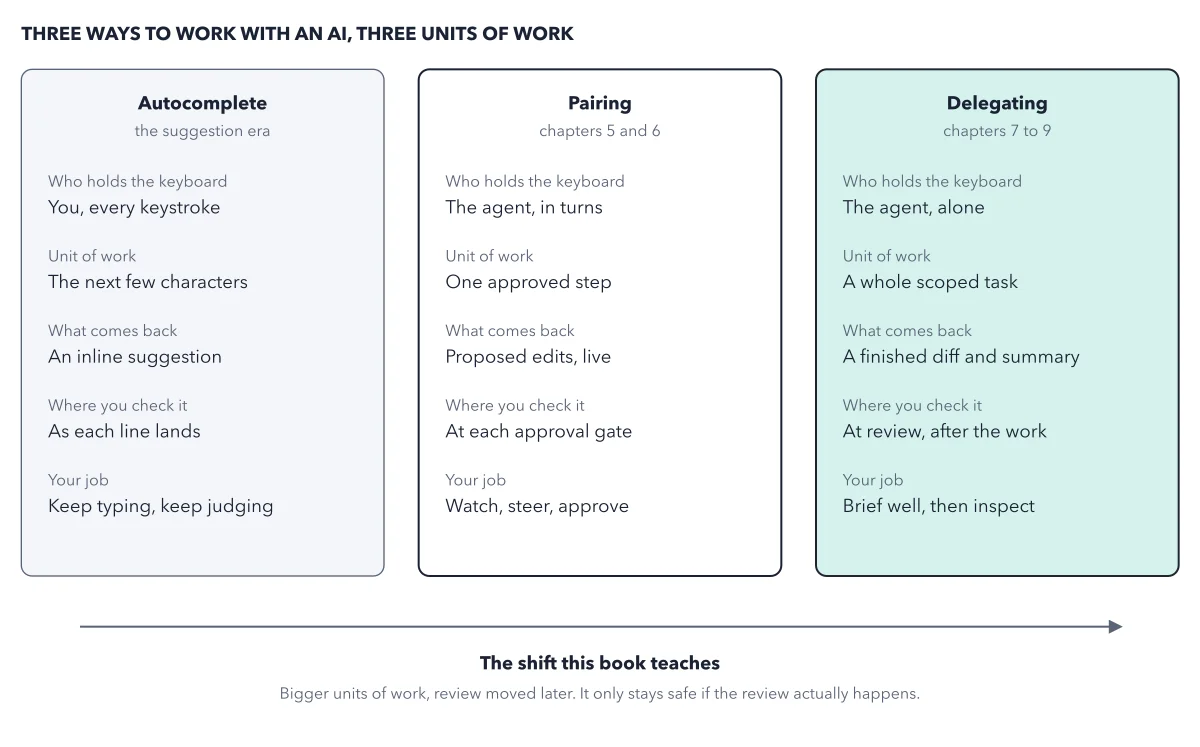
The cause is rarely the AI alone. It is a mismatch between how much work you handed over and when you checked it. That choice is the heart of codex pairing vs delegating. The figure below sets three ways to work with an AI side by side, so you can pick one on purpose and check at the right moment.
How to read this figure
Read each lane from top to bottom. Each column answers the same five questions: who holds the keyboard, the unit of work, what comes back, where you check it, and your job. The unit of work is the amount of work the AI finishes before you look at it.
Autocomplete: you type, it suggests. On the left, you hold the keyboard at every keystroke. The AI suggests the next few characters or lines. You accept or ignore each suggestion as it lands, so you check line by line.
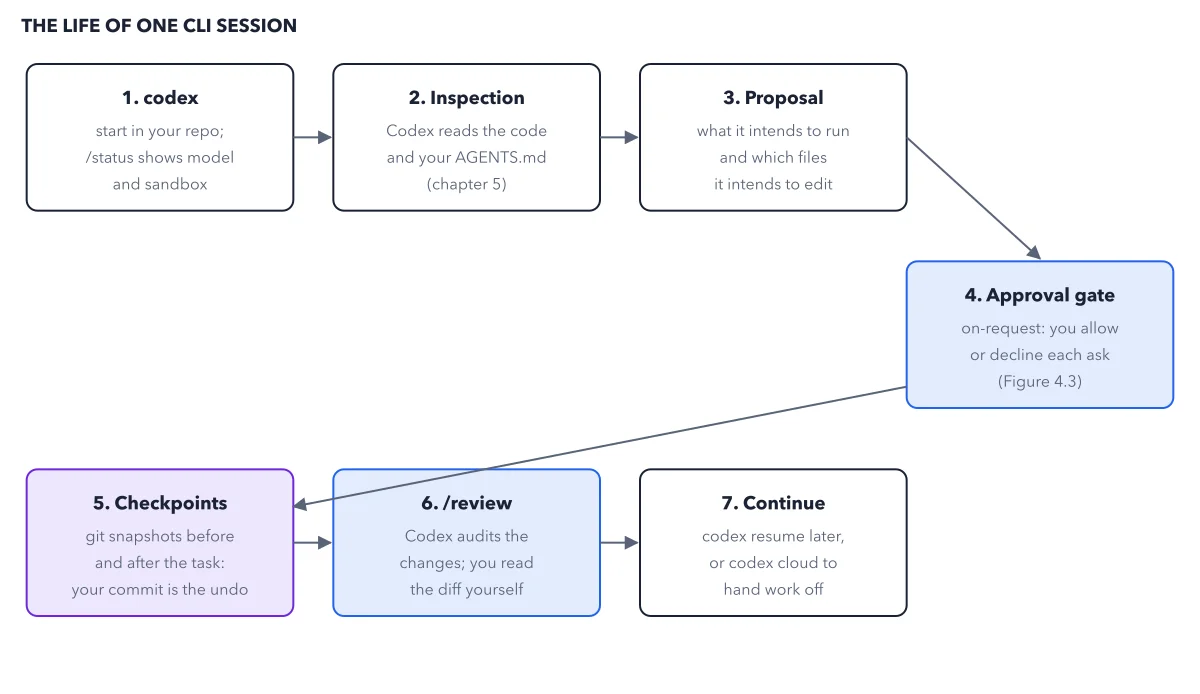
Pairing: the agent works in turns. In the middle, the agent holds the keyboard, but in turns. It proposes one step and shows the edits live. You check at each approval gate: you watch, steer and approve before it takes the next step. See the pairing loop.
Delegating: the agent works alone. On the right, you hand over a whole scoped task: one piece of work with a goal and a way to tell it is finished. The agent brings back a summary and a finished diff, a before and after view of the change that lists each line added and each line removed. Codex shows it on screen. You, or whoever reviews for your team, check once, after the work.
Follow the arrow at the bottom. The arrow runs left to right. The units of work get bigger, and the review moves later. That shift only stays safe if the review happens. Your job never becomes nothing; it moves to the end. For a team, this means review hours, not the agent, set how much you can safely delegate.
Key takeaways
- Choose your lane before you start: the next line, one step, or a whole task.
- Treat every summary as a claim, and read the diff as the evidence.
- Write a definition of done you can check in a minute, then send the task.
Worked example: one date bug, briefed two ways
Take tally, the small invoicing app the book works on. It has a date bug, and you want to delegate the fix.
- The wish: you type “Fix the date bug.” Codex works alone and returns a summary. You have nothing to check it against, so all you can do is trust it.
- The brief: you type “The date test passes, and only files in
src/libchanged.” That folder holds the date code. The sentence is a definition of done, the check that says a task is complete. - The review: you ask in plain words, “run the tests and show me the result.” Then you look at which files the diff touched.
- The warning sign: a diff that touches ten files for a one line fix. You can see that without reading a single line of code.
Result: With the brief, your one check takes a minute and it is real. Without it, you are back to trusting the summary.
Questions readers ask
Do I still need to understand the code Codex writes?
You need to understand the change, not every line. Even if you cannot read code, you can read a diff for its size and for which files it touched, and you can run the tests. If a change you cannot judge touches money or logins, ask a developer to read the diff before you keep it.
Which lane should a beginner start in?
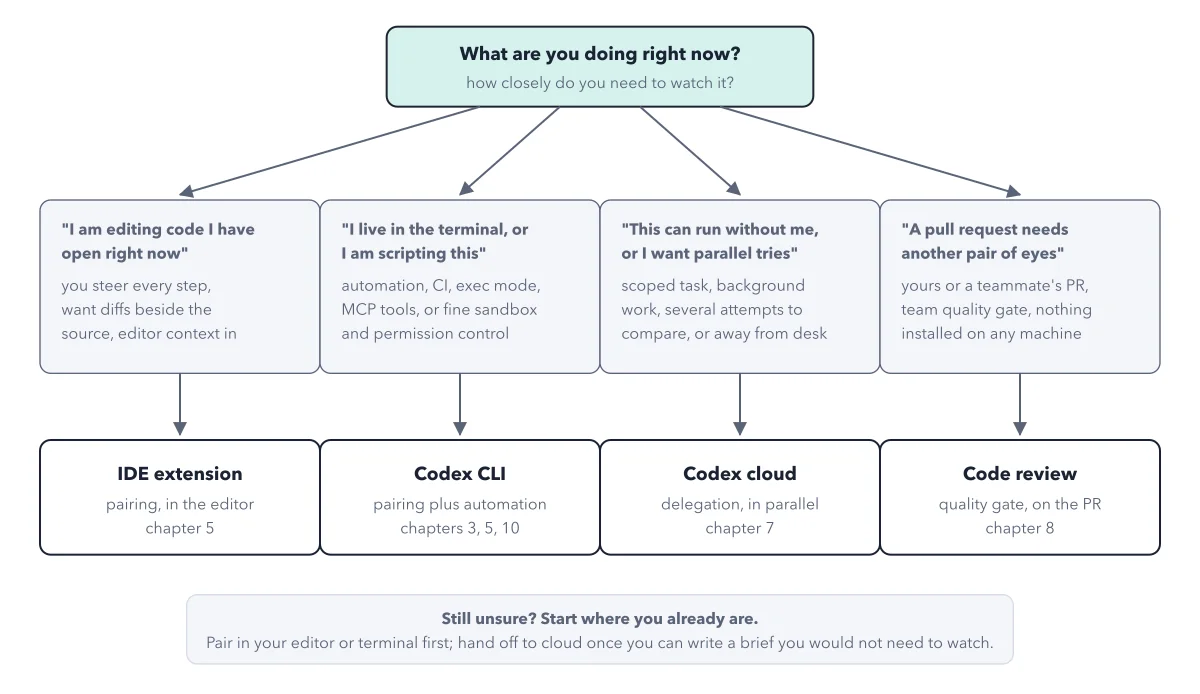
If you do not write code, start by pairing in the ChatGPT desktop app, where you see each step before it happens. If you write code daily, pair in your editor or your terminal. Delegate once you can write a brief you would not need to watch. The surface decision map helps you pick the place.
Does delegating use more of my plan than pairing?
It can. Codex comes with every ChatGPT plan, and your plan meters it on two clocks, a short window and a weekly limit. OpenAI publishes no cost per task, but says cloud tasks may use more of your allowance than local messages. Type /status before and after your first delegated task to get your own number.
Why is building with Codex harder than the demos look?
The one day demo hides three jobs that stay with you: writing the brief, checking the work and fixing what is wrong. A fix that “passed the tests” and broke the app is usually a summary nobody checked: the diff and a real test run would have said so. Pick a lane, write a definition of done, and judge the diff.
Sources: Codex documentation hub (OpenAI); Codex quickstart (OpenAI).
This figure is from OpenAI Codex Made Crystal Clear, chapter 1.
The chapter builds the idea step by step, with recipes you can follow, a Try it to check yourself, and every source.
Get the book