Docker Made Crystal Clear · chapter 2: What a Container Actually Is
The anchor diagram of this book
2026-09-02
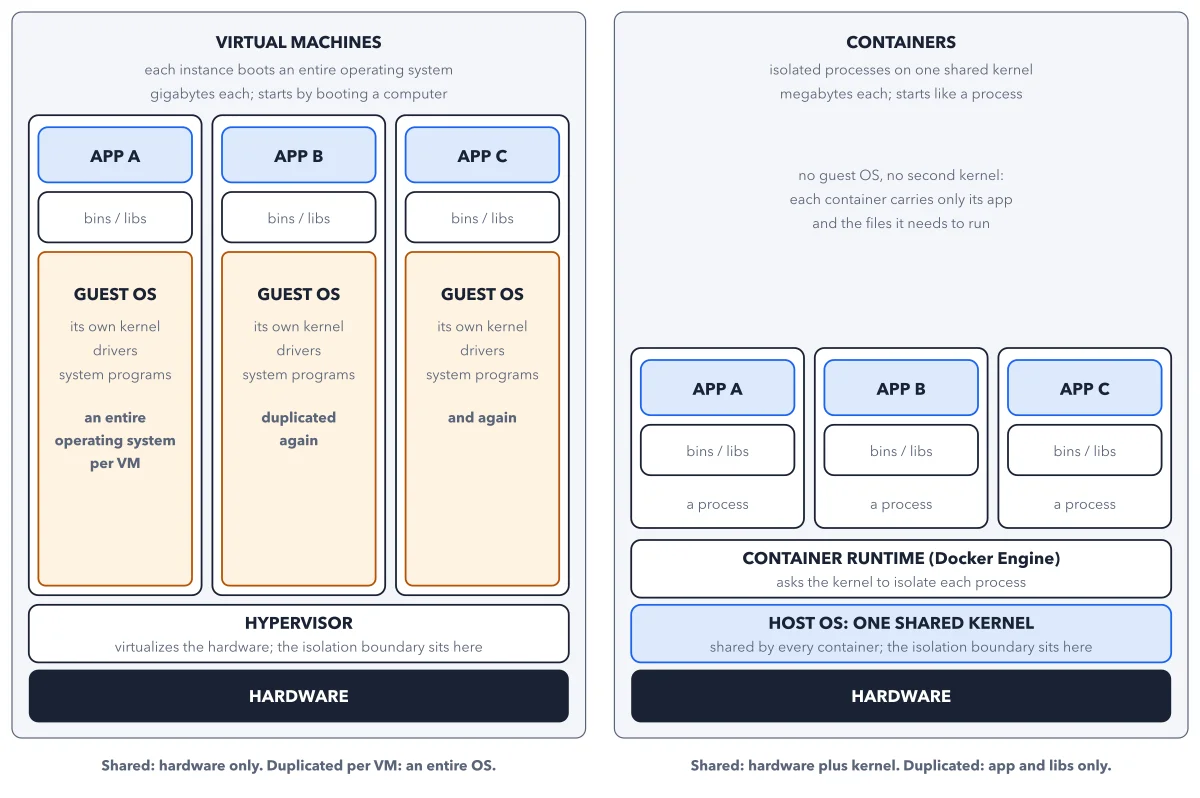
On the left, a hypervisor virtualizes the hardware and every VM repeats a full guest operating system, kernel included. On the right, one host kernel is shared by every container, and each container box holds only an app and its libraries, because a container is a process, not a machine. Note where the isolation boundary sits on each side: virtual hardware for VMs, the shared kernel for containers.
Below: the paragraph from the book that builds this idea, then the diagram itself (Figure 2.1), and a recap. About a minute of reading.
Hold the two stacks side by side and the folklore evaporates. A VM is heavy because each one carries "an entire operating system". A container is light because it carries only its app and files; the docs complete the thought with the efficiency claim: "If you run multiple containers, they all share the same kernel, allowing you to run more applications on less infrastructure." Figure 2.1 is the version of this you should be able to reproduce on demand; the rest of the book leans on it constantly.
Recap
- The idea: On the left, a hypervisor virtualizes the hardware and every VM repeats a full guest operating system, kernel included.
- The picture: Figure 2.1, from chapter 2 ("What a Container Actually Is") of Docker Made Crystal Clear.
- Go deeper: the chapter builds this step by step, with recipes and sources at the end.
This diagram is one of many in Docker Made Crystal Clear.
Every chapter opens with the gist, draws the hard ideas, and ends with recipes and sources.
Get the book