ElevenLabs IVC vs PVC: two clone types, side by side
By Christophe Paka · Facts checked on 30 October 2026
One creator cloned their voice and called it a perfect clone. But it sounded muffled, and the volume went up and down. Their question: would a bigger plan bring better audio?
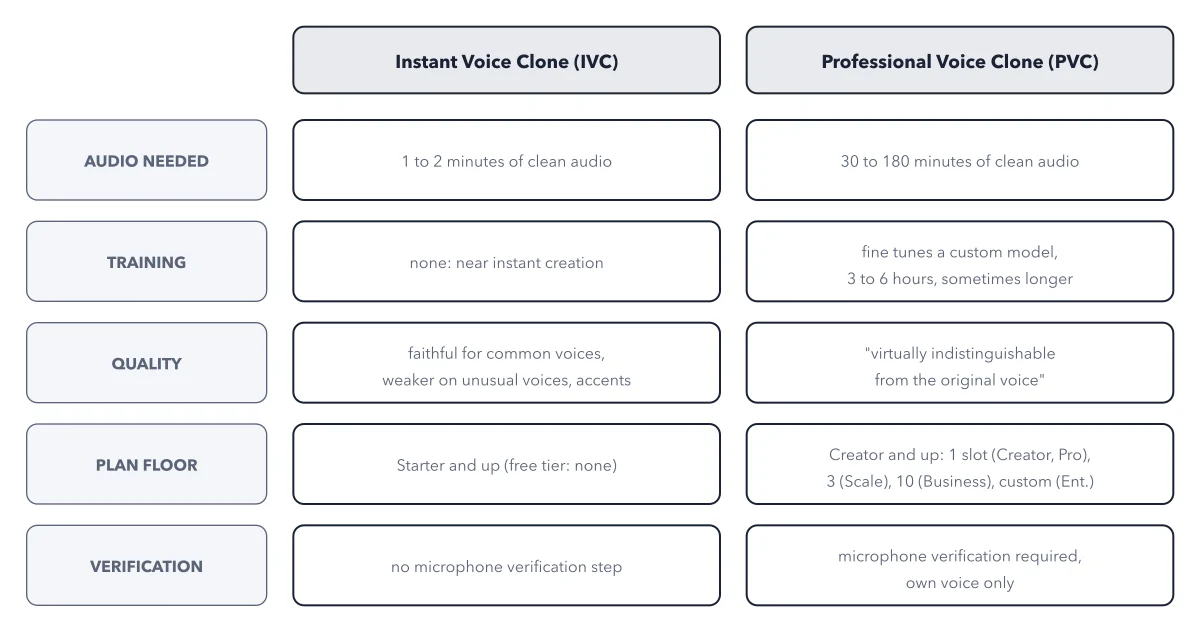
It would not. A plan changes limits, not your recording, so the upgrade costs money and fixes nothing. The real choices are the recording and the clone type. The figure compares ElevenLabs IVC vs PVC row by row: the audio each needs, the training, the quality, the plan floor and the check that proves the voice is yours.
Use this diagram on your site
Free to share in your blog post, docs, course or slides, as long as the credit link stays. Paste the code below where the figure should go.
How to read this figure
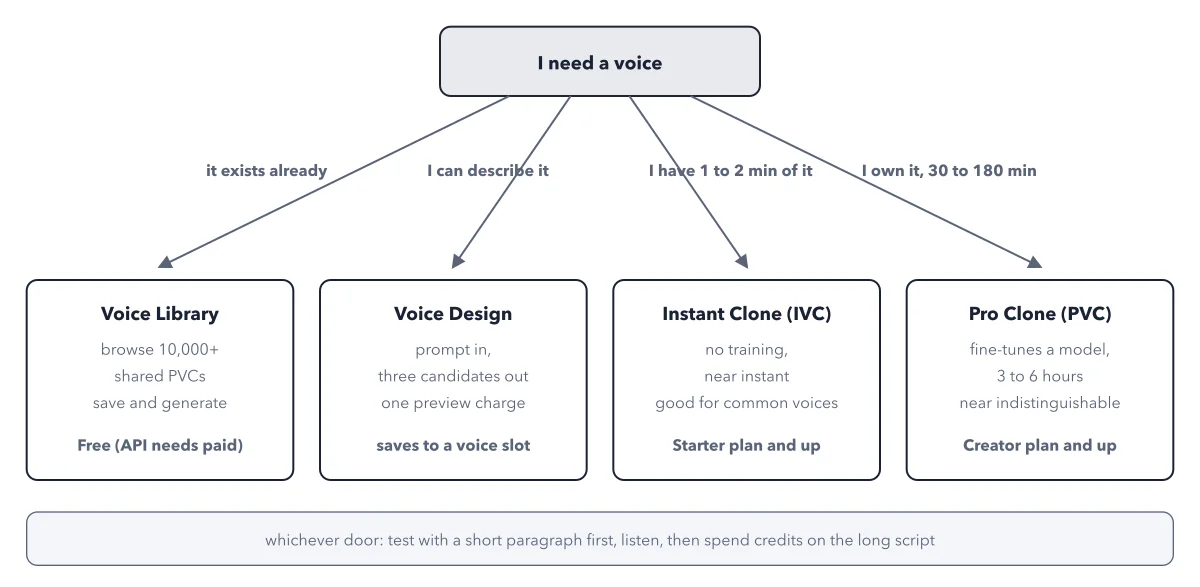
Read the two columns. IVC is an Instant Voice Clone: it copies a voice in moments. PVC is a Professional Voice Clone: ElevenLabs fine tunes a model on your audio, which means it trains the model further on your voice. Still choosing between a clone and a Library voice? See four ways to a voice.
Compare the audio each one needs. An IVC needs 1 to 2 minutes of clean audio. Each file must last at least 5 seconds, and more than 2 to 3 minutes adds little and can hurt. A PVC needs 30 to 180 minutes of your own clean audio.
Compare training and quality. An IVC needs no training. It is faithful for common voices but weaker on unusual voices and accents. A PVC trains for 3 to 6 hours, or up to 24 when many voices wait. The docs call the result virtually indistinguishable from the original voice.
Check the plan floor. An IVC starts on Starter; the free plan has no cloning. A PVC starts on Creator, with one slot on Creator and Pro, three on Scale and ten on Business.
Read the last row: verification. A PVC needs voice verification: you read a prompt aloud into your microphone to prove the voice is yours. It must be your own voice, even if someone else agrees. An IVC has no microphone check, but its consent statements still bind you.
Key takeaways
- Fix a muffled clone in the recording, not the plan: a quiet room beats a bigger subscription.
- Test with an IVC from 1 to 2 clean minutes, then train a PVC for the final work.
- Write the model ID next to the voice ID, and test one paragraph before any model switch.
Worked example: one line, three takes of the same voice
A pottery shop owner clones her own voice to read one line: Welcome to Juniper Ceramics. Only one thing changes per take.
- Take a: 2 minutes recorded in the kitchen, kiln fan running, as an IVC in English. The hum is copied too, and the clone sounds muffled.
- Take b: 2 minutes in a quiet closet, peaks near -6 dB, as an IVC in English. The clone is clean and close to the owner.
- Take c: the clone from take b reads the line in Spanish on Eleven v4. The Spanish is fluent, but her English accent is gone. Eleven v4 drops the reference accent in another language on purpose.
Result: Takes a and b differ only in the room, and the room made the difference. Take c differs only in the model. When a clone changes all of a sudden, look for a model switch before you blame the voice.
Questions readers ask
Will a bigger plan make my voice clone sound better?
No. A plan changes limits, not your recording. The clone learns whatever you feed it, hum included. Record again in a quiet, soft room, about 20 cm from the microphone, in one steady tone. Two even minutes beat ten varied ones.
How much audio do I need for a voice clone?
For an IVC, 1 to 2 minutes of clean audio; more than 2 to 3 minutes adds little and can hurt. For a PVC, 30 to 180 minutes of your own clean audio, then 3 to 6 hours of training.
Can I clone someone else's voice if they agree?
Not as a PVC. The docs say that even with their consent, you cannot clone someone else's voice. A hired narrator makes and verifies their own PVC, then shares it with you by private link. ElevenLabs also blocks celebrity voices and prohibits voices of children.
Why does my clone lose its accent on Eleven v4?
In another language, Eleven v4 drops the reference accent on purpose and speaks the target language fluently. For a PVC on v4, the Clone Strength slider sets how much of the training recordings the voice copies. Start at 0 and raise it a step to keep a distinct accent.
Sources: Voice cloning (ElevenLabs docs); What is Eleven v4? (ElevenLabs help center).
This figure is from ElevenLabs Made Crystal Clear, chapter 4.
The chapter builds the idea step by step, with recipes you can follow, a Try it to check yourself, and every source.
Get the book