Fly.io shared CPU vs performance CPU, priced side by side
By Christophe Paka · Facts checked on 7 November 2026
"Why is my $2 Machine slow?" Readers ask it often. The build that took seconds on a laptop crawls, or the queue worker slows down halfway through a batch. Nothing is broken, and the logs show no error.
The answer sits in the choice of fly.io shared cpu vs performance. The cheap shared CPU is not a small full CPU: it is a small slice of a core plus a savings jar for bursts. Pick the wrong one and you either wait or overpay.
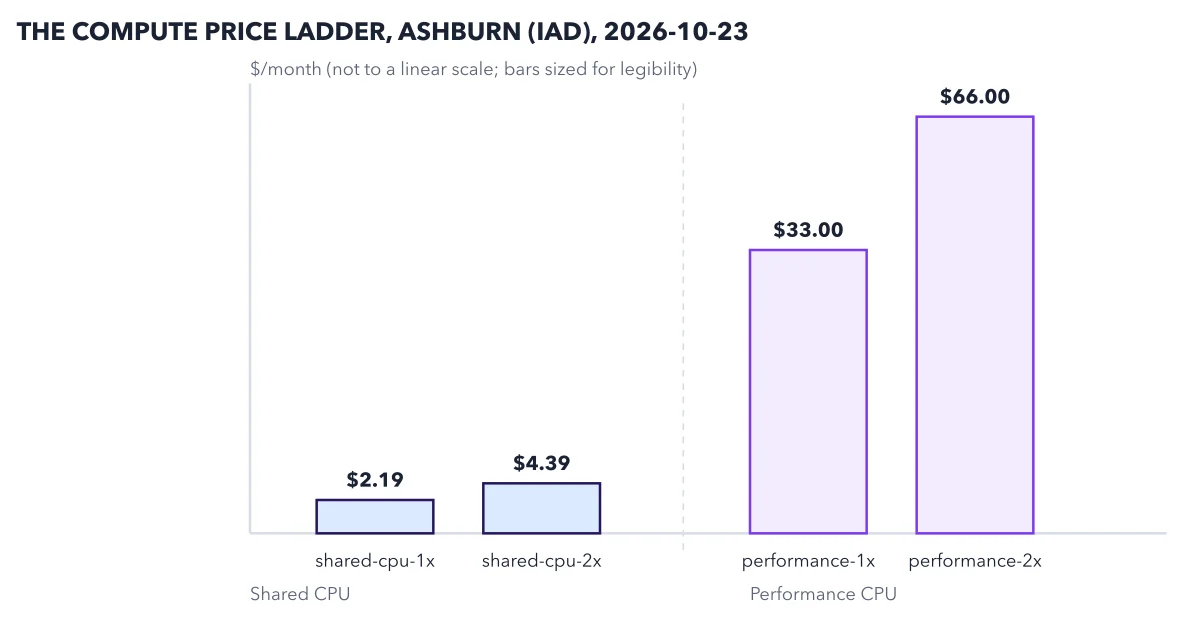
The figure below prices four common sizes as two families, so you can see the gap before you choose.
How to read this figure
See two families, not one ladder. The dashed line splits the chart. Shared CPU Machines sit on the left, performance CPU Machines on the right. The bars are sized so the small ones stay readable, so they are not to scale: read the dollar labels, not the heights.
Read the shared side.
shared-cpu-1xcosts $2.19 andshared-cpu-2x$4.39 for a month always on in Ashburn. A shared CPU is a small steady slice of a core plus a burst allowance, banked time it may spend at full speed.Read the performance side.
performance-1xcosts $33.00 andperformance-2x$66.00. A performance CPU gets a full core all the time, at about 15 times the price of the smallest shared one. Both families run on the same hardware at the same speed.Know what the gap buys. The two families differ only in how much time they may run. Shared suits a web app that idles, then works hard for a moment. Steady heavy work drains a shared Machine's allowance, and then it slows down instead of costing more. Whatever the size, a stopped Machine stops its compute meter; what each Machine state costs shows that bigger lever.
Key takeaways
- Stay on shared CPUs for web apps and workers that are idle most of the time.
- Move to performance only when the metrics dashboard shows the burst balance at zero and requests slowing.
- Size memory on purpose: extra RAM above a size's own amount bills per GB, every month.
Worked example: why a busy shared Machine slows to a crawl
Follow one shared-cpu-1x Machine through a long build, with the numbers from Fly's CPU docs as the book reads them.
- Fly measures CPU time in periods of 80 ms. A shared CPU may use 5 ms of each period, its quota: 6.25%.
- Past its quota, the Machine is throttled, made to wait for the rest of the period. That is one sixteenth of a core.
- Unused time goes into a burst balance, starting at 5 seconds and growing to 500 seconds, which lets the Machine run at full speed for a while.
- A big compile, an image resize or a busy queue drains the balance. Then the Machine falls back to its 6.25%.
Result: Once the balance is gone, a minute of full speed work takes about 16 minutes. More shared Machines will not fix steady heavy work; a performance Machine will.
Questions readers ask
Why is my cheap Fly.io Machine so slow?
It is probably throttled. A shared CPU may run 6.25% of each period, plus whatever burst balance it has banked. Builds, image work and busy queues drain that balance, and then each request waits. Check the burst balance on the Fly metrics dashboard before you resize.
Is a performance CPU faster than a shared one?
Not per moment of work. Both run on the same hardware at the same speed. A performance CPU may run all the time; a shared CPU may run only a small slice of time once its burst balance is spent. You pay for the time, not the speed.
Why does a 1GB Machine cost more than a 512MB one?
Each size includes some memory, 256MB for shared-cpu-1x. Memory above that bills as extra RAM, per GB. That is why the 1GB Machine fly launch picked for Crystal Notes costs $6.70, while 512MB costs $3.69.
Sources: CPU performance (Fly.io docs); Resource pricing (Fly.io docs).
This figure is from Fly.io Made Crystal Clear, chapter 4.
The chapter builds the idea step by step, with recipes you can follow, a Try it to check yourself, and every source.
Get the book