Is Llama open source? Three definitions side by side
By Christophe Paka · Facts checked on 7 November 2026
A buyer, a lawyer or a tender asks one question: is your stack open source? You built on Llama, and Meta called Llama 2 open source at its launch. So is Llama open source? By the strict definition, no.
A wrong yes can cost you a deal. A wrong no undersells a model you may use, change and sell. The answer to give is one phrase: open weights under the Llama Community License. The figure puts Llama's licence in the middle, between the strict definition and the EU's looser one, so you can say why.
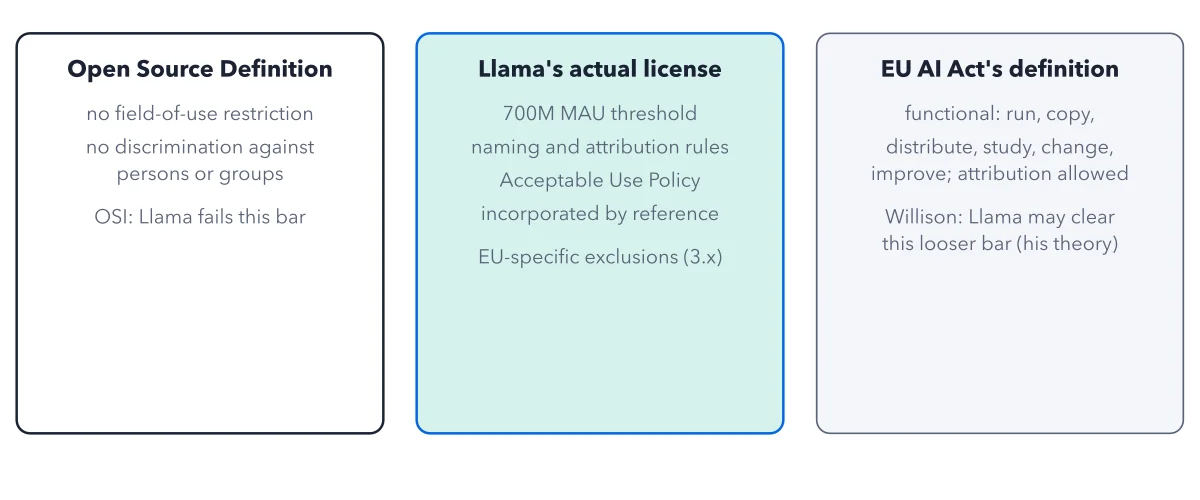
How to read this figure
Start with the strict definition on the left. The Open Source Definition is kept by the Open Source Initiative (OSI), the group that approves open licences. It allows no limit on who may use the work or for what. The box ends with the OSI's verdict: Llama fails this bar. All three boxes carry their meaning in the lines at the top.
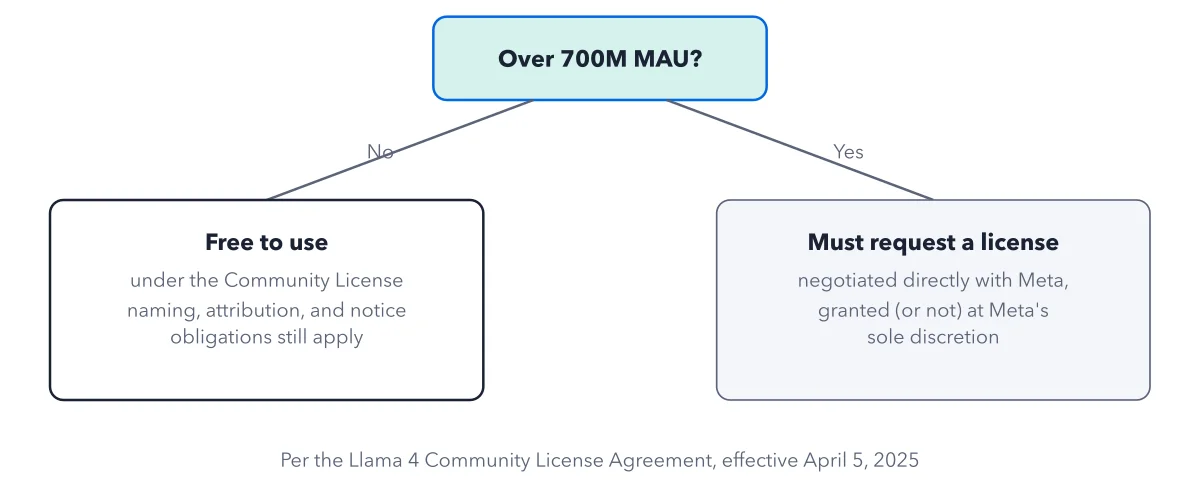
Read Llama's licence in the middle. The middle box lists what the Community License adds: a 700 million user line, naming and attribution rules, and Meta's Acceptable Use Policy, pulled in by reference. From Llama 3.2 on, the image models also carry limits for the EU.
Match each limit to the rule it breaks. The user line limits who may use the work. The use policy limits what for. Those are the two limits the strict definition forbids. So Llama is not open source by that test, even though you may still download it, use it and sell what you build.
Read the looser EU test on the right. The EU AI Act is the European Union's AI law. Its test asks what users may do: run, copy, share, study, change and improve the system, and attribution is allowed. Llama may pass this looser test, but no ruling says so. The box marks it as one developer's theory, Simon Willison's.
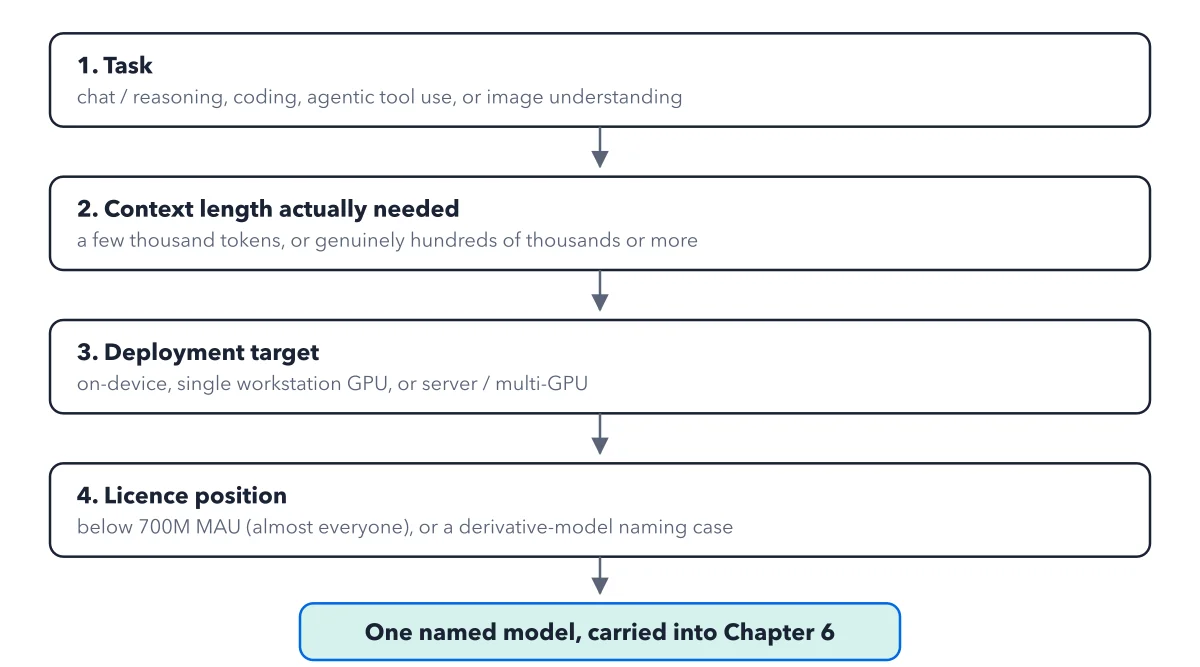
Say the exact phrase. Llama sits between the two outer boxes. Open weights means you may download and run its files. The licence still sets duties, drawn in the one question that decides your licence.
Key takeaways
- Answer "open weights under the Llama Community License" when a buyer, a lawyer or a tender asks for open source.
- Skip the distinction for personal use on your own machine; it matters when a contract names open source.
- Never carry a clause from one licence into another: Muse Glimmer and Muse Spark Open have their own terms.
Try this: test a Llama licence against the strict definition
You need a web browser and the licence for your exact Llama version. No account and no terminal.
- Open the Community License for your version from Meta's developer hub.
- Find the user line in section 2, Additional Commercial Terms. Note it as a limit on who may use the work.
- Open the use policy for the same version and read its numbered list. Note it as a limit on what the work may be used for.
- Find the credit and naming lines in section 1.b.i. Note that the EU test allows attribution, so these lines do not fail it.
Expected result: Two limits the strict definition forbids, so the answer is open weights, not open source. Write that phrase in your sales notes.
Questions readers ask
Is Llama really open source?
No, by the Open Source Definition. The OSI has said so twice. In July 2023 it wrote about Llama 2, and in February 2025 it said Llama 3.x still failed and called the pattern "open washing". Llama is open weights: free to download, use and build on, under conditions.
What is the difference between open weights and open source?
Open weights means you may download and run the model's files. Open source is a stricter claim: the licence must meet the Open Source Definition, which allows no limit on who uses the work or for what. Llama's licence has both kinds of limit.
Why does Meta still call Llama open source?
The licence page itself never uses the phrase. Simon Willison, an independent developer, offers one theory: Meta keeps the name because Llama may pass the EU AI Act's looser test, which allows attribution rules. That is his reading, not a ruling. The OSI's test is the stricter one, and Llama fails it.
Does a Llama I train further keep the same limits?
Yes. A model you make by training Llama on your own examples stays under the licence of the version you built on. You own the changes you make. If you share it or offer it to others, its name must start with "Llama", and the share duties apply.
Sources: Meta's LLaMa license is still not Open Source (OSI); Llama 4 Community License Agreement (Meta); Maybe Meta's Llama claims to be open source because of the EU AI Act (Simon Willison).
This figure is from Llama Made Crystal Clear, chapter 4.
The chapter builds the idea step by step, with recipes you can follow, a Try it to check yourself, and every source.
Get the book