OpenRouter Made Crystal Clear · chapter 4: What OpenRouter Actually Costs
The money map
2026-10-24
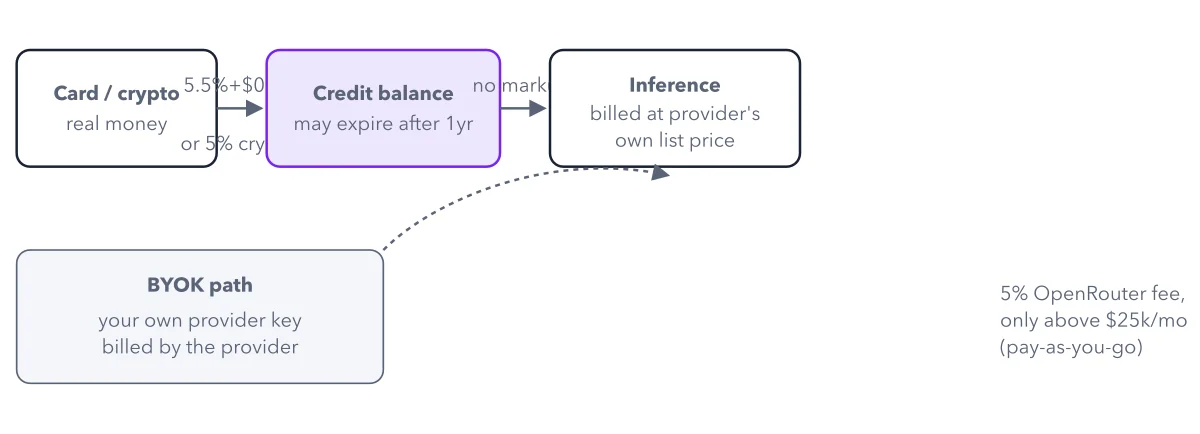
Buying credits carries a one-time fee; spending them on inference carries none. BYOK bypasses credits entirely and pays a 5 percent fee only above a large monthly allowance.
Below: the paragraph from the book that builds this idea, then the diagram itself (Figure 4.1), and a recap. About a minute of reading.
The $0.80 minimum only bites on small purchases. At $200, 5.5 percent is already $11.00, comfortably above the minimum, so a $200 card purchase costs $211.00 total for $200 in usable credits. At $10, 5.5 percent would be $0.55, below the minimum, so the $0.80 floor applies instead, and a $10 purchase actually costs $10.80.
Recap
- The idea: Buying credits carries a one-time fee; spending them on inference carries none.
- The picture: Figure 4.1, from chapter 4 ("What OpenRouter Actually Costs") of OpenRouter Made Crystal Clear.
- Go deeper: the chapter builds this step by step, with recipes and sources at the end.
This diagram is one of many in OpenRouter Made Crystal Clear.
Every chapter opens with the gist, draws the hard ideas, and ends with recipes and sources.
Get the book