Vercel usage pricing explained, one request at a time
By Christophe Paka · Facts checked on 23 October 2026
"Traffic looked normal," a reader wrote above a bill many times his usual plan fee, with nothing unusual in Google Analytics. Others paste invoice lines they cannot name: Fast Origin Transfer, CDN Requests, Provisioned Memory.
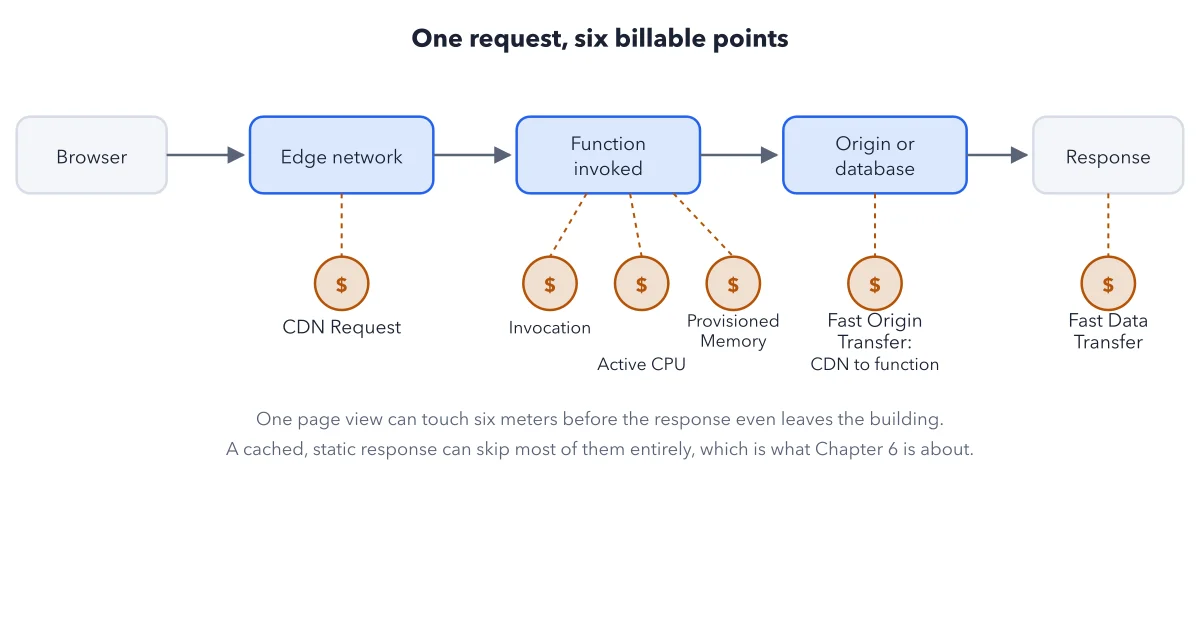
If you cannot name a line, you cannot shrink it, and the next invoice looks the same. Here is Vercel usage pricing explained with one page view. The figure follows it from the browser to the response and drops a coin at each meter it moves. Each coin is a separate line on the bill.
How to read this figure
Browser to the edge network. The request reaches the edge network, Vercel's CDN: its servers around the world, which keep copies of pages close to visitors. The first coin is a CDN Request, one for every request the CDN answers. This meter was called Edge Requests before, so older invoices and forum posts use that name.
Three coins at the function. If the page needs code, a Vercel Function runs. That is one Invocation, one call to a function. Active CPU is the time the processor spends working on your code. Provisioned Memory is the memory the function holds, billed for as long as it is alive, waits included. Active CPU billing shows the two side by side.
Fast Origin Transfer: CDN to function. Fast Origin Transfer counts the bytes that move between the CDN and your function, in both directions. The figure hangs this coin under the origin or database box, but its label is the rule: CDN to function. Your database traffic is not this meter. A page served from the CDN's copy never moves it.
Fast Data Transfer at the response. The answer travels from the CDN to the visitor's device. Those bytes bill as Fast Data Transfer. Every response pays this one, cached or not.
Read the note under the coins. One page view can touch six meters. A cached, static response skips most of them: it costs a CDN Request and its Fast Data Transfer, and no function runs at all. The note's Chapter 6 is the book's caching chapter; Vercel caching layers covers it.
Key takeaways
- Open Usage in your team's dashboard sidebar and sort it by dollars, so the meter that moved shows first.
- Keep pages cached where you can: a cached page moves two meters, a function call six.
- Count bots in your plan: they move CDN Requests and Fast Data Transfer even when analytics misses them.
Worked example: a cached post and a question to the AI box
The book's sample blog, Crystal Notes, has posts that Vercel keeps ready and an ask box at /api/ask that runs a function.
- A visitor opens a post that Vercel keeps ready: 1 CDN Request plus the page's bytes of Fast Data Transfer. Two meters.
- The visitor asks a question at
/api/ask: 1 CDN Request and 1 invocation. - The function computes and waits for the AI model: Active CPU and Provisioned Memory.
- Data goes to and from the function: Fast Origin Transfer. The answer goes back: Fast Data Transfer. Six meters.
Result: Two meters for the post, six for the question. On Pro, Fast Origin Transfer costs from $0.06 per GB, Active CPU from $0.128 per hour, and Provisioned Memory from $0.0106 per GB hour. To lower the bill, find the requests that run code and ask whether they need to.
Questions readers ask
Why is my bill so high when traffic looked normal?
Your analytics may not see bots, because many bots do not run the analytics script. Vercel's counters do. A scraper that sends 5,000,000 requests in one month adds 5,000,000 CDN Requests and their Fast Data Transfer. Sort the usage page by dollars to see which meter moved.
What is Fast Origin Transfer on my invoice?
It is the bytes that move between Vercel's CDN and your functions, both ways. Only requests that run code move it, so a page served from the cache adds nothing. Worry about it when a route sends or receives large responses from a function: cache that route, or send less data.
How do I stop bots from eating my usage?
Bots take the same path as people and bill the same meters: a CDN Request and its data transfer, and more if they reach a function. Vercel's Firewall can deny known AI crawlers, and denied requests are not billed for CDN Requests or Fast Data Transfer. Verified crawlers such as Googlebot stay allowed.
Sources: Vercel Pricing; CDN pricing and usage (Vercel docs); Edge Requests are now called CDN Requests (Vercel changelog).
This figure is from Vercel Made Crystal Clear, chapter 4.
The chapter builds the idea step by step, with recipes you can follow, a Try it to check yourself, and every source.
Get the book