Make vs Zapier vs n8n, decided by how complicated your process is
By Christophe Paka · Facts checked on 23 October 2026
"Spending three hours comparing Zapier and Make is just procrastinating," one reader wrote. "I haven't built a single thing." Other readers ask "Make.com or n8n?" every week, and the threads rarely agree.
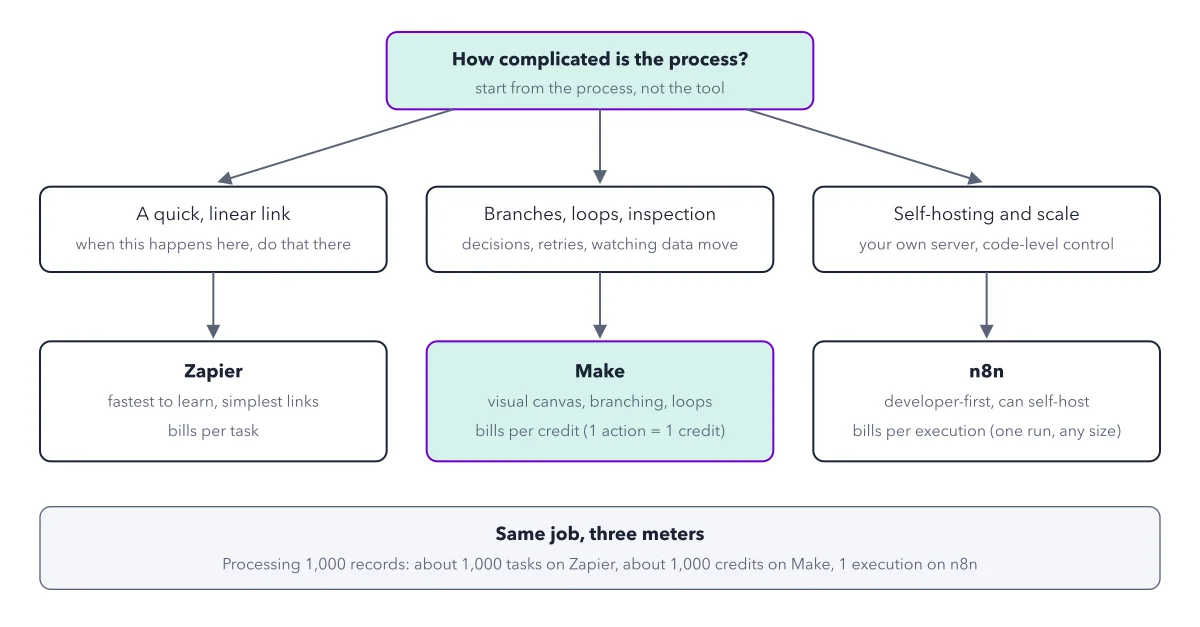
Every evening spent comparing is an evening with no automation running. The make vs zapier vs n8n question has a shorter answer: start from the process, not the tool. The short version for a non coder: Zapier for one straight link, Make once the job has a decision. The figure below draws the whole decision on one page, with the meter, the unit each tool bills by.
How to read this figure
Start with the question at the top. The top box asks one thing: how complicated is the process? It does not ask which tool has more features. Experienced builders give beginners this question instead of a feature list, because the shape of the work picks the platform.
Read the left branch: a quick link. A quick, linear link means when this happens here, do that there, with no decisions. That points to Zapier: fastest to learn, built for simple links. It bills per task, one thing its automation does, such as adding one row.
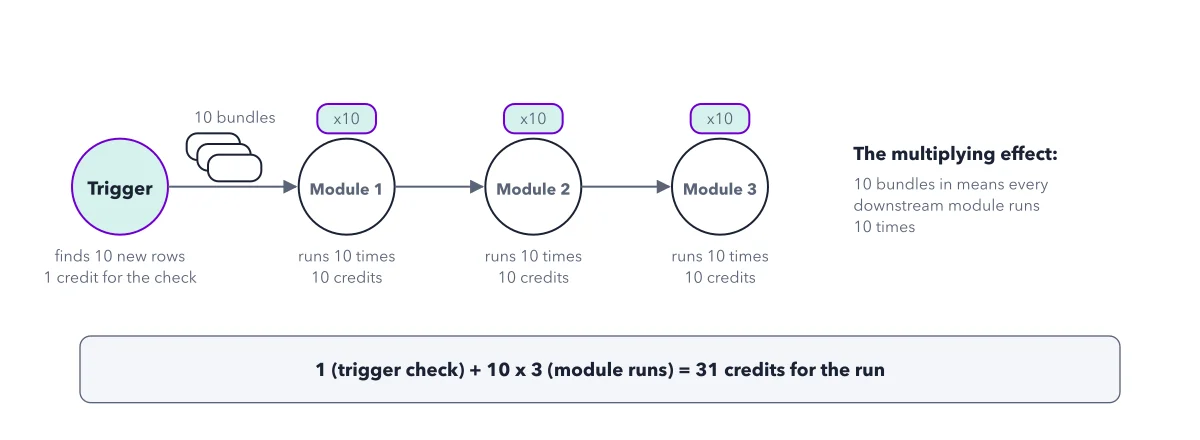
Read the middle branch: branches and loops. Decisions, retries and watching data move point to Make. Its visual canvas shows branches and loops, and you can read what each step received. Make bills per credit: one action, one module doing one thing once, costs one credit. How credits add up in one run counts a real example.
Read the right branch: your own server. Self hosting and scale point to n8n. Self hosting means you run the tool on your own server, a computer you maintain yourself. Code level control means you can change how the tool works, which suits developers. n8n bills per execution: one whole run of the job, however many rows it moves.
Finish on the bottom strip. Same job, three meters. A task or a credit counts each single action, so 1,000 records is about 1,000 tasks on Zapier and about 1,000 credits on Make. An execution counts the whole run, so n8n counts 1. The meter explains most surprise bills, so learn it before you compare prices.
Key takeaways
- Ask how complicated the process is before you compare a single feature or price.
- Learn the meter each tool bills by: tasks on Zapier, credits on Make, executions on n8n.
- Pick Make when your job has a decision point, a retry or a list to work through one by one.
Worked example: three readers, three jobs, one question
Take three readers the book describes, each with one job, and run each one through the figure.
- A freelancer with no coding background builds for clients. Client jobs have branches, and the client wants to see each move the data makes: Make.
- A small business has one chore. If it is one straight link: Zapier. Once it splits, such as if the deal is big, tell sales, and if not, file it: Make.
- A developer with a server and big volume: n8n is worth a look, but price the three meters side by side first.
Result: Each reader gets an answer in minutes, from the shape of the job. The meter then tells each one what the job costs: the same 1,000 records is about 1,000 tasks, about 1,000 credits, or 1 execution.
Questions readers ask
Where does an AI chat app like ChatGPT fit?
An AI chat app is enough for one off work, such as drafting one email. A job that must happen on time, every time, and leave a trail belongs in Make. The two work together: Claude and ChatGPT can start a scenario you built in Make.
Make.com or n8n: which one should a beginner learn?
With no coding background, start with Make: its canvas shows each branch and what each step received. Learn one tool well. The ideas carry over, because every tool has a starting event, steps in order, decisions and a meter. You can switch later.
Does n8n increase your income potential?
Clients do not pay for a tool name. They pay for a result, such as a lead answered in three minutes instead of the next day. What sets your rate is the value of the result and the proof that you deliver it, not the logo on the screen.
Is self hosted n8n free?
The community edition is free to download. But "free if you host it" covers only the software. You still pay for the server and your own hours, and you patch the server yourself. One independent comparison puts n8n at weeks to master, against days to basic skill for Make.
Sources: Make pricing; Zapier pricing; n8n pricing.
This figure is from Make.com Made Crystal Clear, chapter 1.
The chapter builds the idea step by step, with recipes you can follow, a Try it to check yourself, and every source.
Get the book