n8n Made Crystal Clear · chapter 2: How n8n Thinks: Workflows, Nodes, Items
The items pipeline, the anchor schema of this book
2026-09-02
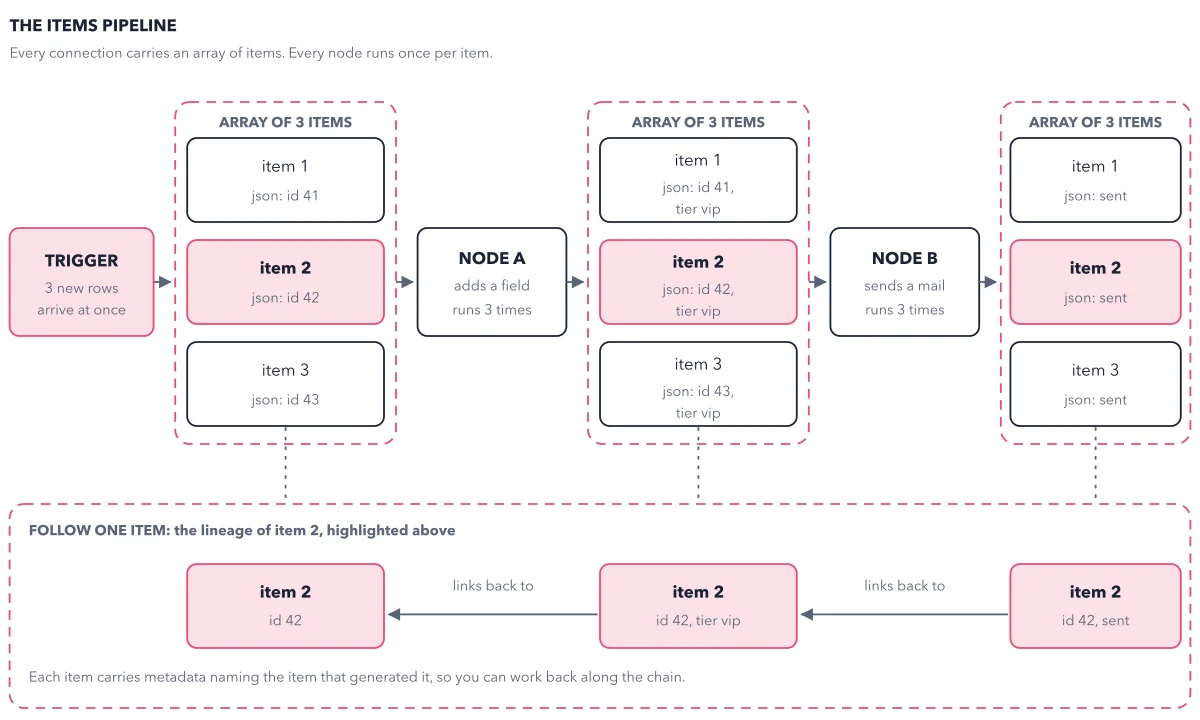
A trigger emits an array of three items. Every connection carries that array, never a bare record. Each node runs its configured operation once per item and outputs new items. The highlighted item 2 keeps its identity the whole way and links back, step by step, to the item that produced it.
Below: the paragraph from the book that builds this idea, then the diagram itself (Figure 2.1), and a recap. About a minute of reading.
Figure 2.1 draws the whole thing in one picture: a trigger emitting three items, two nodes transforming the array, and one item's lineage traced from end to end. Later chapters point back at it constantly, so it is worth a slow look now.
Recap
- The idea: A trigger emits an array of three items.
- The picture: Figure 2.1, from chapter 2 ("How n8n Thinks: Workflows, Nodes, Items") of n8n Made Crystal Clear.
- Go deeper: the chapter builds this step by step, with recipes and sources at the end.
This diagram is one of many in n8n Made Crystal Clear.
Every chapter opens with the gist, draws the hard ideas, and ends with recipes and sources.
Get the book