n8n Made Crystal Clear · chapter 2: How n8n Thinks: Workflows, Nodes, Items
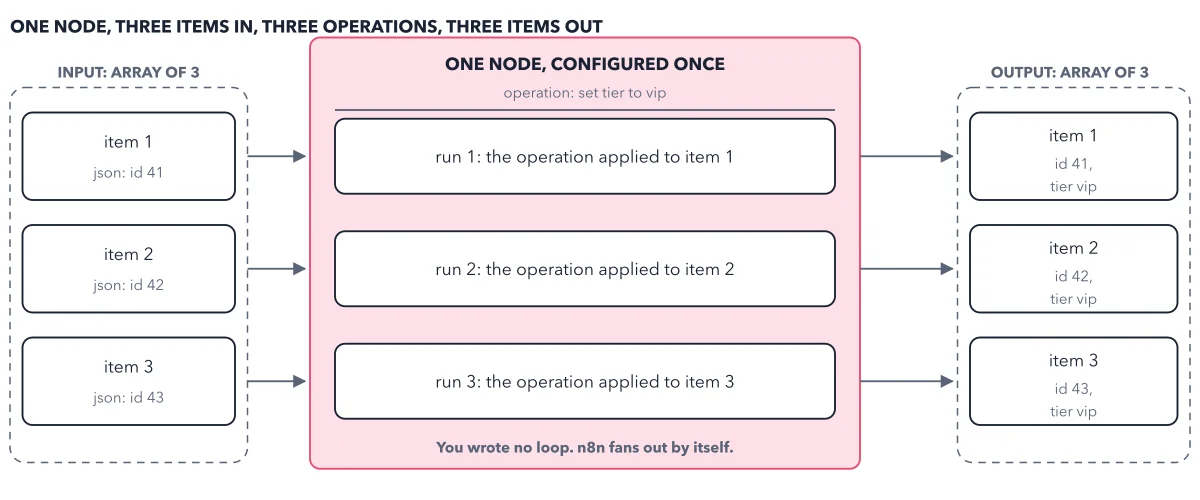
One node, three items in, three items out
2026-09-03
The node is configured once. It performs that configured operation individually for each item in the incoming array, which is why a per-item job needs no loop node at all.
Below: the paragraph from the book that builds this idea, then the diagram itself (Figure 2.2), and a recap. About a minute of reading.
Two items in, two runs of the operation, two items out. If that array had held five hundred entries, the node would have run five hundred times. This is the single biggest difference between n8n and writing a script: in a script you write the loop, and here the loop is the platform's default behaviour. Figure 2.2 zooms into one node so you can see it happening.
Recap
- The idea: The node is configured once.
- The picture: Figure 2.2, from chapter 2 ("How n8n Thinks: Workflows, Nodes, Items") of n8n Made Crystal Clear.
- Go deeper: the chapter builds this step by step, with recipes and sources at the end.
This diagram is one of many in n8n Made Crystal Clear.
Every chapter opens with the gist, draws the hard ideas, and ends with recipes and sources.
Get the book