Supabase Made Crystal Clear · chapter 1: Why Supabase
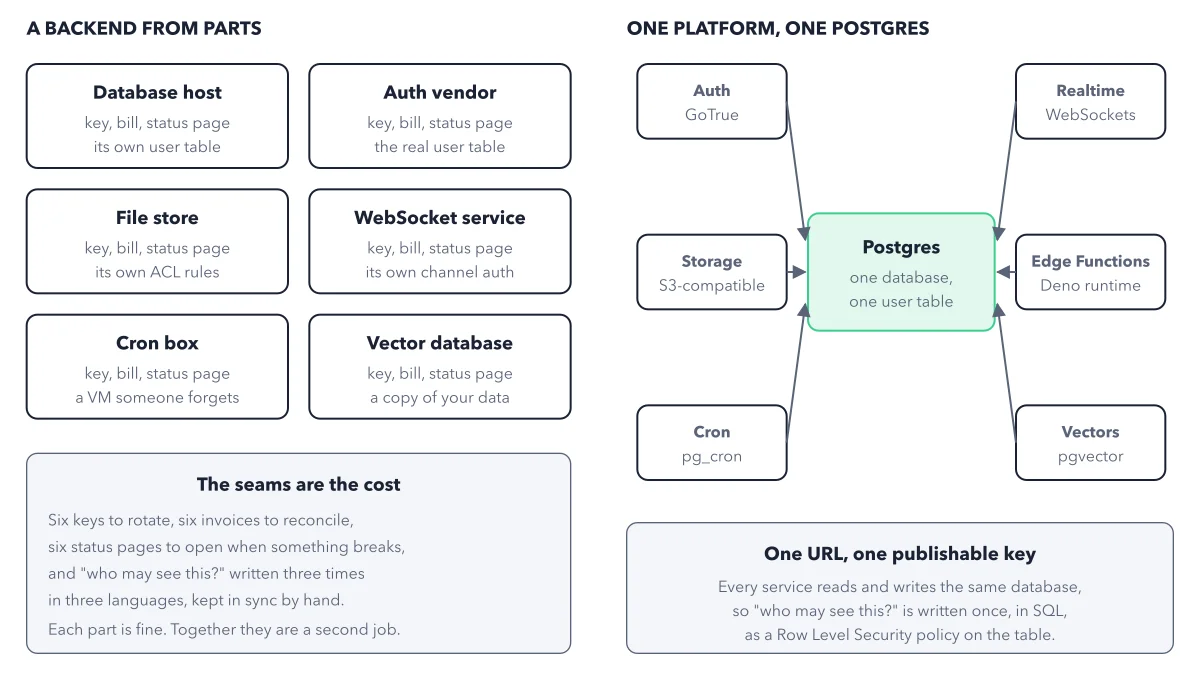
A backend from parts versus one platform
2026-08-29
Left, six vendors with six keys, six bills, and six status pages. Right, the same six capabilities as services around one Postgres, reached through one URL and one publishable key, with the access rule written once as a policy on the table.
Below: the paragraph from the book that builds this idea, then the diagram itself (Figure 1.1), and a recap. About a minute of reading.
Every part has its own API key, so your secrets file grows and rotation means six dashboards. Every part has its own bill, so a $9 line item here and a $20 line item there add up to a number nobody chose. Every part has its own status page, so when the app misbehaves you open six tabs to find out whose fault it is. And every part has its own idea of who the user is, so "user 42 may read file X" is a rule you re-implement three times, in three languages, and keep in sync by hand. Figure 1.1 draws the two shapes side by side.
Recap
- The idea: Left, six vendors with six keys, six bills, and six status pages.
- The picture: Figure 1.1, from chapter 1 ("Why Supabase") of Supabase Made Crystal Clear.
- Go deeper: the chapter builds this step by step, with recipes and sources at the end.
This diagram is one of many in Supabase Made Crystal Clear.
Every chapter opens with the gist, draws the hard ideas, and ends with recipes and sources.
Get the book