
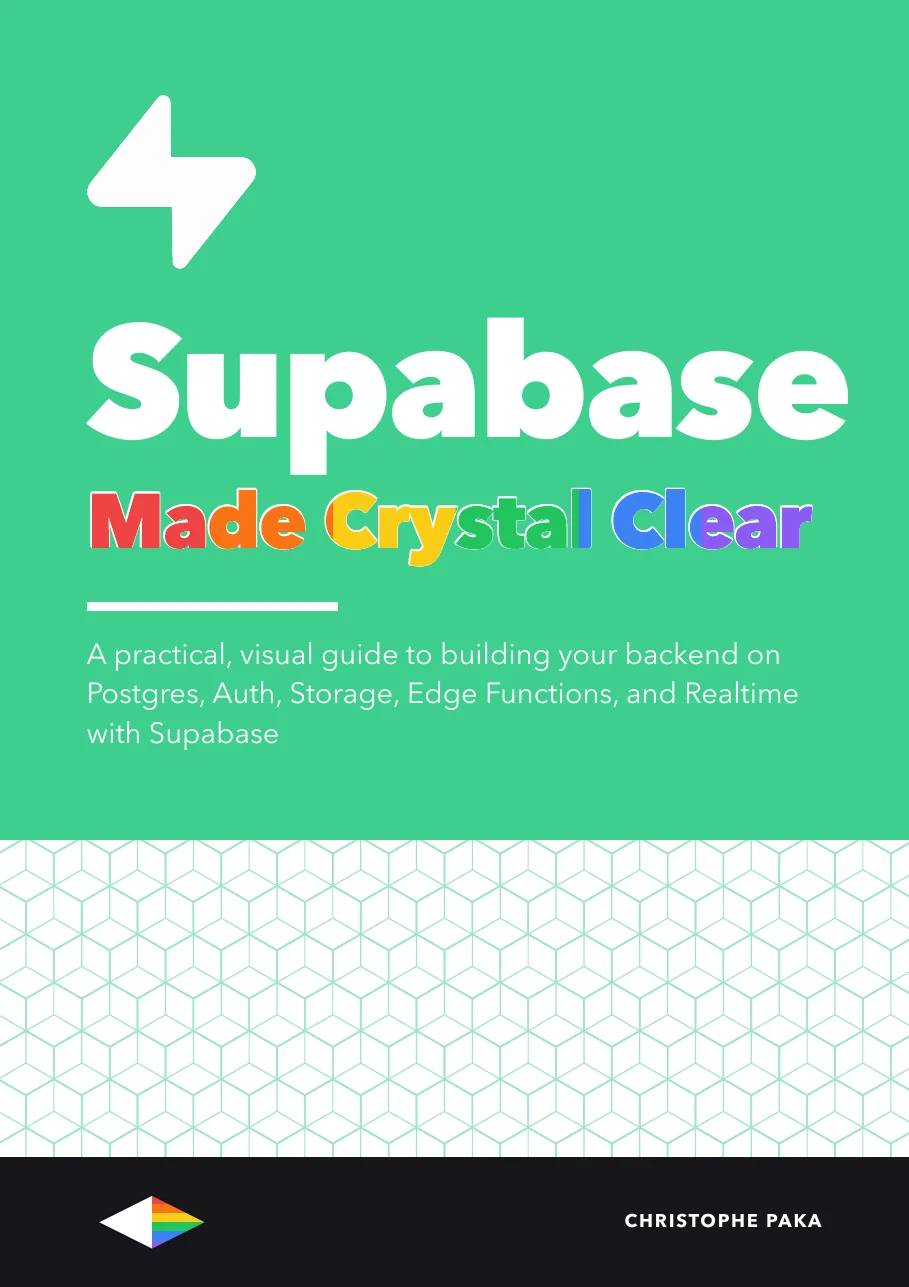
Supabase
Made Crystal Clear
 By Christophe Paka · Updated October 23, 2026
A Visual Beginner's Guide to Postgres, Auth, and Row Level Security
Prefer it on your Kindle, or on paper? Same book, on Amazon.
Who this book is for
In plain words: Supabase gives your app a ready made backend: a Postgres database, user logins, file storage, and server functions, without building any of it yourself.
- Developers and founders building an app that needs data and logins
- Lovable and other AI app builders who want to understand their backend
- Not for: Not for you if you have never written a line of code. Try Lovable Made Crystal Clear.
Your app talks to its database straight from the browser, so the question every builder asks is: is it safe? This visual beginner's guide shows you what runs under your Supabase app, and how to prove it is locked. Inside, you will learn to model a Postgres schema and query it from your app; write Row Level Security policies you can read aloud, and test them as two users; add sign in with email, OAuth and magic links; store files in private buckets with signed URLs; ship Edge Functions, Realtime and search by meaning (vector search with pgvector); and keep migrations in Git, go live with an audit and backups, and work out the monthly bill. Sixteen chapters, 64 diagrams and 27 step by step recipes. Every idea has a diagram, every recipe is numbered with the result you should see, and every chapter ends with a Try it to check yourself. The words stay plain, and the real terms stay in. Whether you are a vibe coder, a solo founder, a developer choosing a backend or a team lead with a multi tenant app, one app, Crystal Desk, goes from a first project to production.
- Pages
- 279
- Level
- Beginner to advanced
- Updated
- October 23, 2026
12 real pages. Click a page to enlarge it.
Is this you?
- Your app works in dev, but you suspect it is a security holeChapter 5: Row Level Security
- Your query returns an empty array and no errorChapter 3: Your First Project
- Your bill went up when you added a second project, and you do not know whyChapter 13: What It Costs: Plans, Compute, and the Real Bill
- You cannot decide between Supabase and Firebase, and you want to pick onceChapter 1: Why Supabase, and Is It for You?
- You keep reading that people move away from Supabase for productionChapter 15: The Business Case: Stay, Restructure, or Leave
- You want to self-host on a cheap VPS and need to know what you give upChapter 14: Self-Hosting
16 chapters · 64 diagrams · 27 recipes · 42 checklists · 165 glossary terms · 189 sources
Inside the book
- 01Why Supabase, and Is It for You?
- 02The Mental Model: One Postgres, Keys, and Roles
- 03Your First Project
- 04Postgres and the Data API
- 05Row Level Security
- 06Auth: Sign In, Sessions, and Trusted Claims
- 07Storage
- 08Edge Functions and Scheduled Work
- 09Realtime
- 10AI, Vectors, and Coding Agents
- 11Migrations, Local Development, and Branches
- 12Go Live: Audit, Backups, and Monitoring
- 13What It Costs: Plans, Compute, and the Real Bill
- 14Self-Hosting
- 15The Business Case: Stay, Restructure, or Leave
- 16Your 90 Days, Cheat Sheet, and Resources
You'll leave with
- See how Postgres, Auth, Storage, Functions, and Realtime fit together
- Create a project, model a schema, and query it from your app
- Write Row Level Security policies you can reason about
About the author
Christophe Paka writes every book on the shelf. He spent years in technical support at Salesforce and Microsoft, where the job was to make complex systems clear to customers who needed them working the same day. He has since built and run software as a founder and lead developer, worked as a Salesforce consultant, and grown a YouTube channel on tech careers past one million views.
This book was last updated on October 23, 2026.
Connect on LinkedIn →For teams
Put Supabase on every desk at your company.
One licence, every book in the series, one link for everyone. From $250 a year.
Sources
Every source cited in Supabase Made Crystal Clear. Each number matches the [n] marker next to that link in the book's "Go deeper" lists, so you can trace any claim back to its origin.
- [1]Supabase architecture
- [2]Database overview
- [3]API keys
- [4]supabase/supabase on GitHub
- [5]Supabase Series F announcement
- [6]TechCrunch: Supabase doubles valuation to $10B (June 2026)
- [7]TechCrunch: Supabase nabs $5B valuation (October 2025)
- [8]Firestore data model
Show all 189 sources
- [9]Firebase pricing
- [10]Migrating to the new API keys
- [11]Securing your API
- [12]Client libraries
- [13]Choosing a server package
- [14]PostgREST authentication
- [15]Use Supabase with Next.js
- [16]Tables and data
- [17]Supabase CLI getting started
- [18]Database advisors
- [19]Custom SMTP
- [20]Build with AI tools
- [21]with-supabase Next.js template
- [22]Database functions
- [23]Indexes
- [24]Full text search
- [25]Joins and nesting
- [26]supabase-js reference (llms/js.txt)
- [27]Connecting to Postgres
- [28]Prisma
- [29]PostgREST tables and views API
- [30]Row Level Security
- [31]Testing overview
- [32]Custom claims and RBAC
- [33]RLS performance discussion #14576
- [34]PostgreSQL: Row Security Policies
- [35]AxonBuild: Supabase RLS performance
- [36]CVE-2025-48757 disclosure (Matt Palmer)
- [37]Auth overview
- [38]Sessions
- [39]JWT signing keys
- [40]Creating a server client
- [41]Server-side advanced guide
- [42]Auth rate limits
- [43]Enable CAPTCHA protection
- [44]Monthly Active Users usage
- [45]Storage overview
- [46]Access control
- [47]Resumable uploads
- [48]S3 authentication
- [49]Downloads
- [50]Smart CDN
- [51]Image transformations
- [52]File limits
- [53]Storage size usage
- [54]Edge Functions overview
- [55]Auth in Edge Functions
- [56]Limits
- [57]Secrets
- [58]Background tasks
- [59]Scheduling functions
- [60]Database webhooks
- [61]Regional invocation
- [62]Edge Functions pricing
- [63]Realtime overview
- [64]Realtime getting started
- [65]Broadcast
- [66]Subscribing to database changes
- [67]Postgres Changes
- [68]Realtime authorization
- [69]Presence
- [70]Realtime limits
- [71]Realtime Peak Connections usage
- [72]Vector columns
- [73]Vector indexes
- [74]Semantic search
- [75]Hybrid search
- [76]Automatic embeddings
- [77]Queues
- [78]Cron
- [79]MCP server
- [80]pgvector README
- [81]Local development
- [82]CLI workflows
- [83]Database migrations
- [84]Declarative database schemas
- [85]Seeding your database
- [86]Generating TypeScript types
- [87]CLI reference
- [88]Branching
- [89]Working with branches
- [90]Branching usage and cost
- [91]Managing environments
- [92]supabase-action-example
- [93]Going into production
- [94]Observability overview
- [95]Shared responsibility model
- [96]Personal access tokens
- [97]Pricing
- [98]Billing on Supabase
- [99]Cost control
- [100]Compute and disk
- [101]Compute usage
- [102]Read replicas
- [103]Point-in-time recovery usage
- [104]Upgrading
- [105]Self-hosting overview
- [106]Self-hosting with Docker
- [107]supabase-kubernetes
- [108]supabase-traefik
- [109]HIPAA compliance
- [110]GDPR compliance
- [111]Self-hosted vs managed PostgreSQL
- [112]PostgreSQL high availability (Percona)
- [113]Security overview
- [114]Neon pricing
- [115]PlanetScale pricing
- [116]Convex pricing
- [117]Firestore to Supabase migration (Emergence Engineering)
- [118]Supabase Evals
- [119]Getting Started
- [120]Pooling and limits
- [121]AI and Vectors overview
- [122]SOC 2 compliance
- [123]Organization Legal Documents page
- [124]Data Processing Agreement (DPA)
- [125]PostgreSQL manual: CREATE POLICY
- [126]MakerKit: Supabase RLS best practices
- [127]DesignRevision: Supabase vs Neon (2026)
- [128]Supabase changelog
- [129]Supabase status
- [130]llms.txt
- [131]Supabase CLI releases
- [132]Breaking Change: Tables not exposed to Data and GraphQL API automatically (GitHub discussion 45329)
- [133]Supabase changelog: Logs usage-based pricing
- [134]Manage Logs Ingest usage
- [135]Manage Pipelines usage
- [136]Supabase changelog: Multigres private alpha
- [137]Supabase changelog: OrioleDB public beta
- [138]Supabase changelog: Scoped personal access tokens GA
- [139]Supabase changelog: Framework adapters in @supabase/server are deprecated
- [140]Supabase is acquiring Turso
- [141]Supabase Select 2026: Build anything (Supabase from code, MCP server for your app, Compute)
- [142]Supabase Select 2026: Operate with confidence
- [143]Supabase Select 2026: Scale without limits (Multigres, OrioleDB, dbarena)
- [144]Declarative Schemas 2.0 with pg-delta
- [145]A local Supabase project per agent, with or without Docker
- [146]Faster config, migrations and functions on branches
- [147]Branching without Git is now the default
- [148]Supabase Middleware
- [149]Postgres Changes gets AND filters, new operators, and column selection
- [150]Sync real-time Stripe data to Supabase with Stripe Data Pipeline
- [151]Sign in with ChatGPT is in beta on Supabase
- [152]Introducing the unified Supabase .NET SDK
- [153]Passkey authentication
- [154]Custom OAuth/OIDC providers
- [155]OAuth 2.1 Server
- [156]Supabase MCP server (getting started)
- [157]Diff engines: pg-delta and migra
- [158]Docker and native runtimes
- [159]HNSW indexes
- [160]Running AI models in Edge Functions
- [161]Analytics Buckets
- [162]Vector Buckets
- [163]Supabase CLI PR 7108: removed in v3 deprecation warnings
- [164]Supabase MCP server releases
- [165]Supabase self-hosted releases
- [166]supabase/postgres release versions (postgres_release.yml)
- [167]@supabase/supabase-js on npm (latest, engines)
- [168]UptimeRobot: Supabase incidents 2026-09-24 (third party)
- [169]Understanding Database and Disk Size
- [170]Billing FAQ
- [171]Get set up for billing
- [172]GraphQL
- [173]Passwordless email logins
- [174]Auth Hooks
- [175]supabase-js reference: signUp
- [176]Password-based Auth
- [177]Database Backups
- [178]Rate Limiting Edge Functions
- [179]Manage Realtime Messages usage
- [180]Can't access Supabase project when using Lovable Cloud
- [181]Lovable: Deployment, hosting, and ownership options
- [182]Backup and Restore using the CLI
- [183]Multi-factor authentication (Dashboard)
- [184]Regions
- [185]Databricks agrees to acquire Neon (press release)
- [186]How I migrated from Firebase to Supabase (Joe Ashwell)
- [187]Lovable: Deploying and hosting outside Lovable
- [192]Lovable vulnerabilities (Superblocks)
- [196]Billing FAQ
Also in the series
37 more titles, one tool or topic each. Swipe or use the arrows.

AI Go To Market
Available
Higgsfield
Available
Kubernetes
Available
Cloudflare
Available
Jev
Available
AI Video
Available
Zernio
Available
Make.com
Available
Codex
Available
Hugging Face
Available
Modal
Available
Lovable
Available
Vapi
Available
n8n
Available
AI Agents
Available
Tech Hiring
Available
ElevenLabs
Available
AI
Available
Claude Code
Available
Git
Available
Kimi Code
Available
Hermes Agent
Available
GitHub
Available
Docker
Available
Qwen
Available
Llama
Available
DeepSeek
Available
OpenRouter
Available
GLM
Available
Gemini
Available
Mistral
Available
OpenClaw
Available
Grok Bot
Available
Vercel
Available
Fly.io
Available
Cursor
Available
The +1 Method
AvailableNew books, in your inbox
One short note when a new Made Crystal Clear guide ships.
No spam, unsubscribe anytime.