Supabase Made Crystal Clear · chapter 2: Architecture: One Postgres
The big schema
2026-09-20
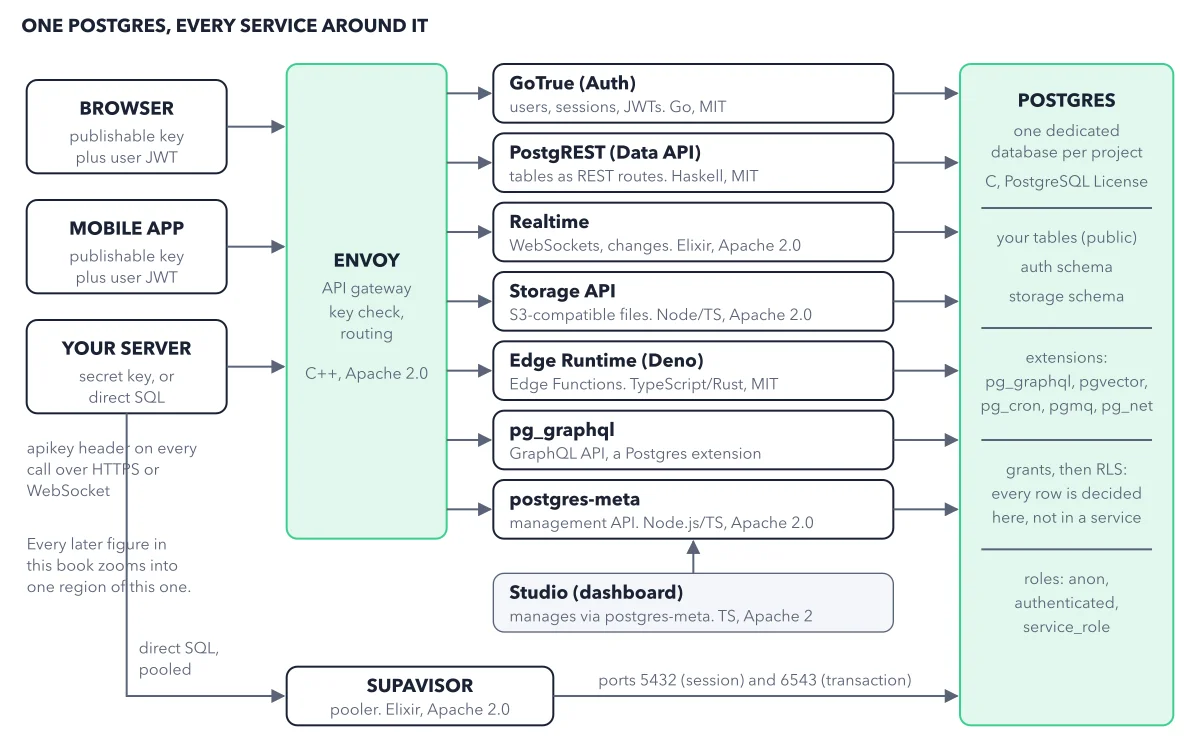
Clients enter through the Envoy gateway, seven services read and write one dedicated Postgres, Studio manages it through postgres-meta, and servers that want plain SQL use the Supavisor pooler lane. Languages and licenses are from the official architecture page as of 2026-09-18.
Below: the paragraph from the book that builds this idea, then the diagram itself (Figure 2.1), and a recap. About a minute of reading.
Figure 2.1 is the master diagram for this book. Clients sit on the left: a browser, a mobile app, and your own server. Every API call from them enters through the Envoy gateway (Kong, which the self-hosting stack still offers as an optional override, chapter 14). The gateway checks the API key and routes the call to one of seven services. All seven talk to one Postgres. Studio, the open source component behind the Dashboard, manages the database through postgres-meta. Servers that want plain SQL skip the gateway and go through Supavisor, the connection pooler, straight to Postgres. Each box carries its language and license, because "everything is open source" is a claim you can check per component.
Recap
- The idea: Clients enter through the Envoy gateway, seven services read and write one dedicated Postgres, Studio manages it through postgres-meta, and servers that want plain SQL use the Supavisor pooler lane.
- The picture: Figure 2.1, from chapter 2 ("Architecture: One Postgres") of Supabase Made Crystal Clear.
- Go deeper: the chapter builds this step by step, with recipes and sources at the end.
This diagram is one of many in Supabase Made Crystal Clear.
Every chapter opens with the gist, draws the hard ideas, and ends with recipes and sources.
Get the book