Make.com Made Crystal Clear · chapter 1: The Automation Problem (and Where Make Fits)
From Integromat to Make
2026-09-06
A bootstrapped Czech startup, a $100 million-plus acquisition, a rebrand, and the 2026 move into AI agents.
Below: the paragraph from the book that builds this idea, then the diagram itself (Figure 1.3), and a recap. About a minute of reading.
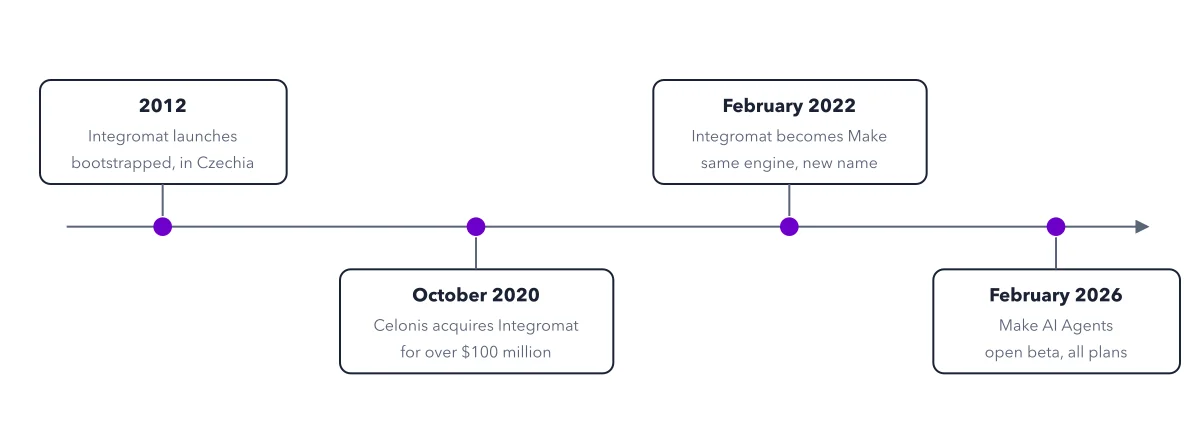
Integromat launched in 2012 as a bootstrapped Czech startup: no outside funding, engineering-first, and quietly successful. By 2020 it had grown to about 60 employees, roughly $10 million in revenue, and more than 11,000 customers; TechCrunch described it at the time as "an enterprise version of Zapier". On October 14, 2020, Celonis, the process-intelligence company, acquired it for over $100 million. The logic was complementary: Celonis analyzes how work actually flows through a company, and Integromat could automate the fixes across applications. On February 22, 2022, the product was rebranded as Make, on make.com. In 2026 Make remains part of Celonis, run as a dedicated business unit with its own product and engineering team. Figure 1.3 puts the milestones on one line.
Recap
- The idea: A bootstrapped Czech startup, a $100 million-plus acquisition, a rebrand, and the 2026 move into AI agents.
- The picture: Figure 1.3, from chapter 1 ("The Automation Problem (and Where Make Fits)") of Make.com Made Crystal Clear.
- Go deeper: the chapter builds this step by step, with recipes and sources at the end.
This diagram is one of many in Make.com Made Crystal Clear.
Every chapter opens with the gist, draws the hard ideas, and ends with recipes and sources.
Get the book