
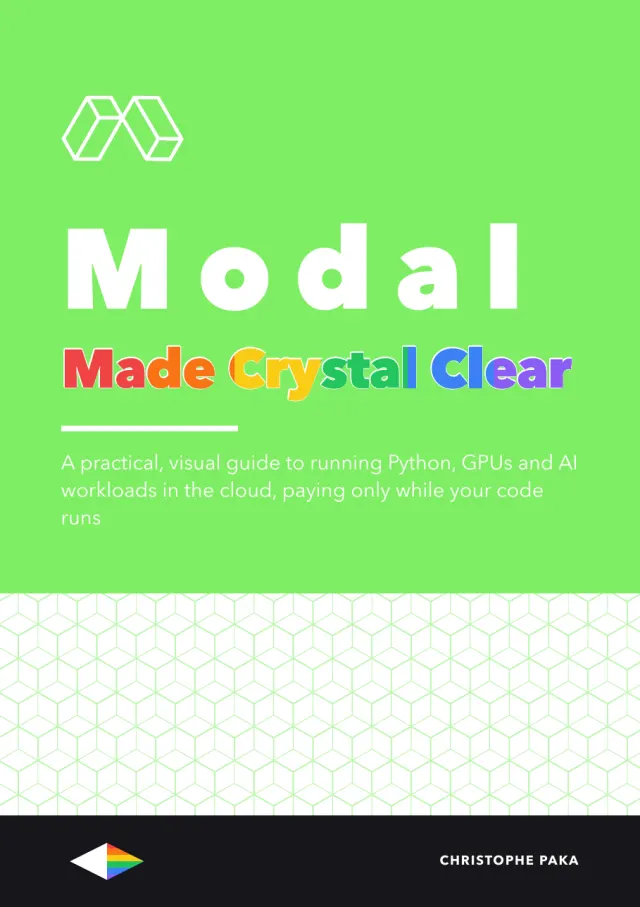
Modal
Made Crystal Clear
 By Christophe Paka · Updated August 28, 2026
A practical, visual guide to running Python, GPUs and AI workloads in the cloud, paying only while your code runs
Prefer it on your Kindle, or on paper? Same book, on Amazon.
Who this book is for
In plain words: Modal runs your Python code and AI models on cloud GPUs, and you pay only for the seconds your code is actually running.
- Python developers and ML engineers who need GPUs now and then
- Technical founders serving an AI model without a platform team
- Not for: Not for you if you don't write Python. Try Hugging Face Made Crystal Clear.
Every GPU tutorial ends the same way: a machine you forgot to turn off. Modal sells the other unit, functions and seconds. This guide takes you from pip install modal to a deployed vLLM endpoint your OpenAI client code already speaks, through environments written as Python, cron jobs and web APIs that cost pennies a month, GPUs picked by arithmetic instead of spreadsheet, and Sandboxes for code an LLM wrote. It treats the catches as content: cold starts measured before the levers, and the break-even worksheet that says when per-second billing stops winning. Every price is dated and every vendor claim is attributed.
- Pages
- 198
- Level
- Beginner to advanced
- Updated
- August 28, 2026
12 real pages. Click a page to enlarge it.
Inside the book
- 01The End of Paying for Idle
- 02The Big Picture: How Modal Thinks
- 03Zero to Cloud in Ten Minutes
- 04Images: Your Environment as Python Code
- 05Python in the Cloud 24/7: Cron Jobs and Web Endpoints
- 06GPUs on Demand: Picking Hardware Without a Spreadsheet
- 07Volumes: Where Model Weights Live
- 08Ship an LLM Endpoint: vLLM in Production Shape
- 09Cold Starts, Solved Honestly
- 10Scaling Out: Map, Spawn, and Training Runs
- 11Sandboxes: A Safe Room for Untrusted Code
- 12The Money Chapter: What Modal Really Costs
- 13Production: Secrets, Regions, Budgets, and Sleep
- 14Your 90-Day Path and the One-Page Cheat Sheet
- 15Resources: The Short List Worth Your Time
You'll leave with
- Understand what happens between your decorator and a billed second, and why idle costs zero
- Write your environment as Python, with model weights baked in at build time
- Ship a cron job and a locked web endpoint for pennies a month, no GPU required
About the author
Christophe Paka writes every book on the shelf. He spent years in technical support at Salesforce and Microsoft, where the job was to make complex systems clear to customers who needed them working the same day. He has since built and run software as a founder and lead developer, worked as a Salesforce consultant, and grown a YouTube channel on tech careers past one million views.
This book was last updated on August 28, 2026.
Connect on LinkedIn →For teams
Put Modal on every desk at your company.
One licence, every book in the series, one link for everyone. From $250 a year.
Sources
Every source cited in Modal Made Crystal Clear. Each number matches the [n] marker next to that link in the book's "Go deeper" lists, so you can trace any claim back to its origin.
- [1]Modal homepage
- [2]Modal customer stories
- [3]Latent Space: "Truly Serverless Infra for AI Engineers"
- [4]Erik Bernhardsson: "What I have been working on: Modal"
- [5]Coiled: a GPU-accelerated serverless alternative to AWS Lambda
- [6]Hacker News: practitioners on Modal
- [7]Modal pricing
- [8]Functions guide
Show all 53 sources
- [9]Images guide
- [10]Autoscaling guide
- [11]Hello world example
- [12]Web endpoints guide
- [13]Modal changelog
- [14]Edlitera's Modal tutorial
- [15]modal.com/docs/guide/images
- [16]modal.com/docs/guide/existing-images
- [17]modal.com/docs/examples/hello_world
- [18]Scheduling remote cron jobs
- [19]The Server primitive
- [20]GPU acceleration guide
- [21]Billing guide
- [22]GPU cold starts and VRAM math
- [23]Volumes guide
- [24]Cloud bucket mounts
- [25]Dicts
- [26]Queues
- [27]Deploying a vLLM server on Modal
- [28]Modal docs: Functions
- [29]Modal docs: Web endpoints
- [30]Modal docs: Volumes
- [31]Modal docs: GPU acceleration
- [32]Modal: Cold start performance
- [33]Modal: Memory snapshots
- [34]Modal: GPU memory snapshots
- [35]Modal: GPU snapshot example
- [36]Modal: engineering talk on the container stack
- [37]Scaling out (Modal docs)
- [38]Substack case study (Modal)
- [39]Sandboxes guide
- [40]Sandboxes product page
- [41]The safe_code_execution example
- [42]JavaScript and Go SDKs
- [43]Security guide
- [44]Budgets
- [45]Introl: serverless GPU platforms compared
- [46]GPU Tracker: serverless GPU comparison
- [47]Secrets guide
- [48]Region selection
- [49]Developing and debugging
- [50]OpenTelemetry integration
- [51]Managing deployments
- [52]Web Function URLs
- [53]modal.com
Also in the series
37 more titles, one tool or topic each. Swipe or use the arrows.

AI Go To Market
Available
Higgsfield
Available
Kubernetes
Available
Cloudflare
Available
Jev
Available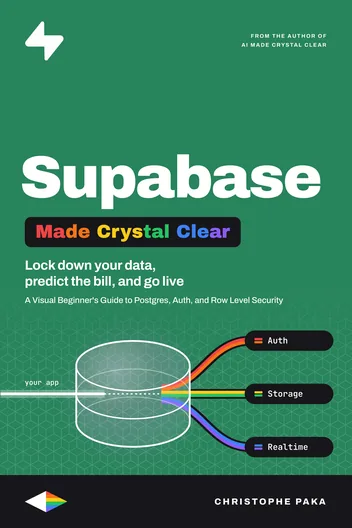
Supabase
Available
AI Video
Available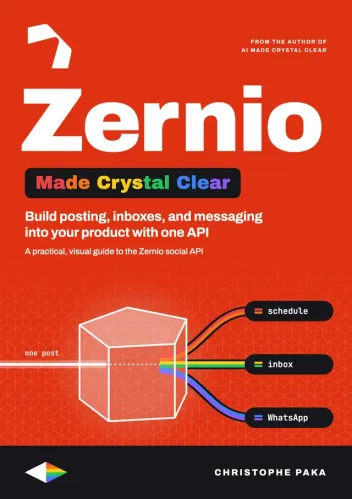
Zernio
Available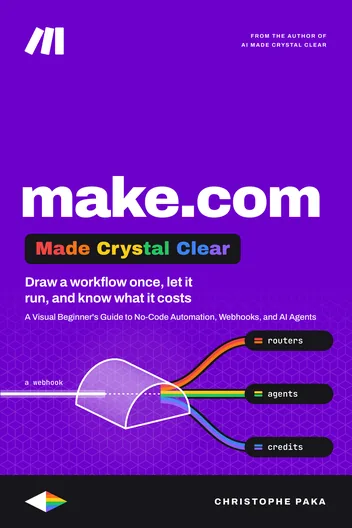
Make.com
Available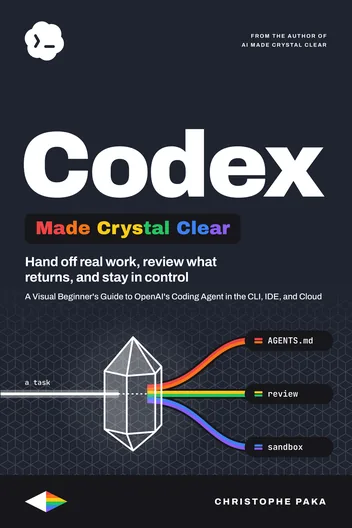
Codex
Available
Hugging Face
Available
Lovable
Available
Vapi
Available
n8n
Available
AI Agents
Available
Tech Hiring
Available
ElevenLabs
Available
AI
Available
Claude Code
Available
Git
Available
Kimi Code
Available
Hermes Agent
Available
GitHub
Available
Docker
Available
Qwen
Available
Llama
Available
DeepSeek
Available
OpenRouter
Available
GLM
Available
Gemini
Available
Mistral
Available
OpenClaw
Available
Grok Bot
Available
Vercel
Available
Fly.io
Available
Cursor
Available
The +1 Method
AvailableNew books, in your inbox
One short note when a new Made Crystal Clear guide ships.
No spam, unsubscribe anytime.