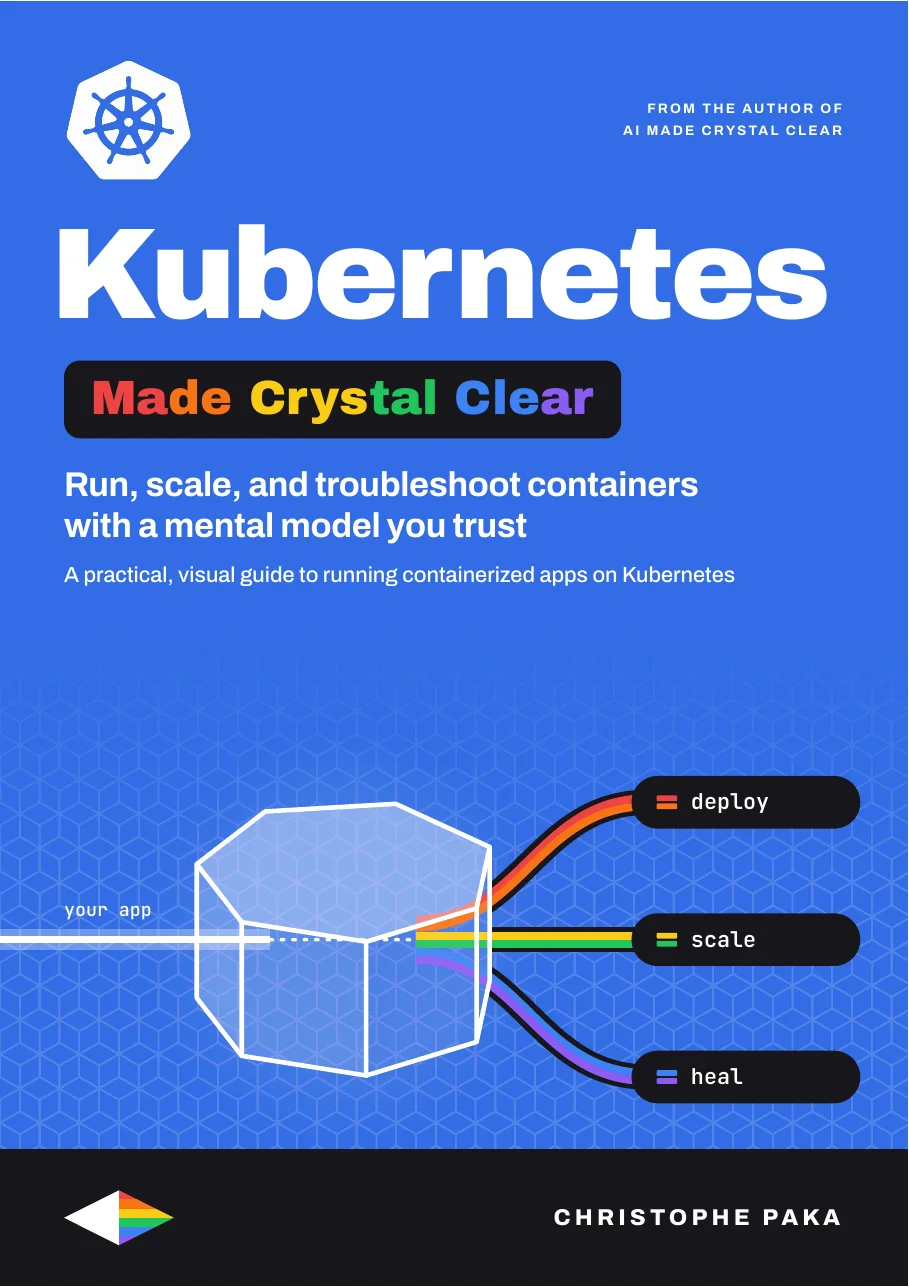
Kubernetes
Made Crystal Clear
A practical, visual guide to running, scaling, and troubleshooting containerized apps on Kubernetes
Kubernetes runs containers across many machines and keeps them in the state you describe. This guide starts with the honest question, do you even need it, then builds the mental model, a free laptop cluster, and real deployments: Pods, Services, Gateway API, config, storage, Helm, autoscaling, troubleshooting, security, and the real cost of managed clusters. One rule throughout: describe the state you want, then check what the cluster did.
- Pages
- 381
- Level
- Beginner to advanced
- Status
- Available
Inside the book
- 01Do You Even Need Kubernetes?
- 02The Mental Model: Desired State, Control Plane, Nodes
- 03Your First Cluster in Ten Minutes
- 04Speaking Kubernetes: Manifests, kubectl, Labels, Namespaces
- 05Pods and Deployments: Running Your App
- 06Services: How Traffic Finds Your Pods
- 07Getting Traffic In: Gateway API, Ingress, and the Ingress-NGINX Retirement
- 08Configuration, Secrets, and Storage
- 09Deploy a Real App: From Compose File to Cluster
- 10Packaging: Helm, Kustomize, or Plain YAML
- 11Scaling: Requests, Limits, and Autoscaling
- 12Observability: Logs, Metrics, and Events
- 13Troubleshooting by Status: Pending, CrashLoopBackOff, ImagePullBackOff
- 14Security Basics: Exposure, NetworkPolicy, RBAC, Pod Security
- 15Managed Kubernetes, the Real Bill, and the Business Case
- 16Production Readiness and Upgrades
- 17Your 90-Day Path and Cheat Sheet
You'll leave with
- Decide whether your team needs Kubernetes yet
- Draw the control plane, nodes, and the desired-state loop
- Run a free multi-node cluster on your laptop
For teams
Put Kubernetes on every desk at your company.
One licence, every book in the series, one link for everyone. From $250 a year.
Sources
Every source cited in Kubernetes Made Crystal Clear. Each number matches the [n] marker next to that link in the book's "Go deeper" lists, so you can trace any claim back to its origin.
- [1]Overview
- [2]Kubernetes Components
- [3]Borg: The Predecessor to Kubernetes
- [4]Learning environment
- [5]Production environment
- [6]Docker Compose overview
- [7]K3s documentation
- [8]CNCF Annual Cloud Native Survey 2025 announcement
- [9]CNCF FinOps microsurvey 2023
- [10]You might not need Kubernetes (Jessie Frazelle)
- [11]Maybe You Don't Need Kubernetes (Matthias Endler)
- [12]"Let's use Kubernetes!" Now you have 8 problems
- [13]Is Kubernetes too Complex? (Fairwinds)
- [14]An Update on Heroku
- [15]Cluster Architecture
- [16]Controllers
- [17]Objects In Kubernetes
- [18]The Kubernetes API
- [19]Communication between Nodes and the Control Plane
- [20]Nodes
- [21]Kubernetes Self-Healing
- [22]Kubernetes Scheduler
- [23]Owners and Dependents
- [24]Garbage Collection
- [25]Container Runtimes
- [26]etcd documentation
- [27]Install Tools
- [28]Install kubectl on macOS
- [29]Install and Set Up kubectl on Linux
- [30]Install kubectl on Windows
- [31]Version Skew Policy
- [32]kind Quick Start
- [33]kind releases
- [34]minikube start
- [35]Hello Minikube
- [36]K3s quick start
- [37]k3d
- [38]kubectl Quick Reference
- [39]Killercoda Kubernetes playground
- [40]Kubernetes Object Management
- [41]Declarative Management Using Configuration Files
- [42]Server-Side Apply
- [43]Command line tool (kubectl)
- [44]Labels and Selectors
- [45]Recommended Labels
- [46]Annotations
- [47]Namespaces
- [48]Organizing Cluster Access Using kubeconfig Files
- [49]JSONPath Support
- [50]KYAML Reference
- [51]Declarative Management Using Kustomize
- [52]Pods
- [53]Pod Lifecycle
- [54]Liveness, Readiness, and Startup Probes
- [55]Configure Liveness, Readiness and Startup Probes
- [56]Init Containers
- [57]Sidecar Containers
- [58]Deployments
- [59]ReplicaSet
- [60]StatefulSets
- [61]DaemonSet
- [62]Jobs
- [63]CronJob
- [64]Services, Load Balancing, and Networking
- [65]Service
- [66]EndpointSlices
- [67]DNS for Services and Pods
- [68]Virtual IPs and Service Proxies
- [69]Connecting Applications with Services
- [70]Debug Services
- [71]Debugging DNS Resolution
- [72]kind: LoadBalancer
- [73]kind: Ingress
- [74]Gateway API (kubernetes.io)
- [75]Gateway API getting started and install
- [76]Gateway API releases
- [77]Gateway API implementations
- [78]Ingress
- [79]Ingress Controllers
- [80]Ingress NGINX Retirement: What You Need to Know
- [81]Ingress NGINX: Statement from the Steering and Security Response Committees
- [82]Before You Migrate: Five Surprising Ingress-NGINX Behaviors
- [83]Announcing Ingress2Gateway 1.0
- [84]ingress-nginx repository (archived)
- [85]cloud-provider-kind README
- [86]Ingress-NGINX is discontinued: the path to Gateway API (cloudmagazin)
- [87]ConfigMaps
- [88]Secrets
- [89]Good practices for Kubernetes Secrets
- [90]Managing Secrets using kubectl
- [91]Encrypting Confidential Data at Rest
- [92]Secrets Store CSI Driver
- [93]Kubernetes Configuration Good Practices
- [94]Volumes
- [95]Persistent Volumes
- [96]Storage Classes
- [97]Configure a Pod to Use a PersistentVolume for Storage
- [98]kind default storage (source)
- [99]The Twelve-Factor App
- [100]Example: Deploying WordPress and MySQL with Persistent Volumes
- [101]Gateway API project site
- [102]Kompose
- [103]Helm: Introduction
- [104]Helm: Installing Helm
- [105]Helm: Quickstart
- [106]Helm: Using Helm
- [107]Helm: Charts
- [108]Helm: Chart Template Guide
- [109]Helm: Values Files
- [110]Helm 4 Overview
- [111]Helm 3 End of Life
- [112]Helm: Version Support Policy
- [113]Helm: Advanced Techniques
- [114]Artifact Hub
- [115]CNCF: Helm unaffected by vendor deprecations
- [116]Resource Management for Pods and Containers
- [117]Pod Quality of Service Classes
- [118]Limit Ranges
- [119]Resource Quotas
- [120]Autoscaling Workloads
- [121]Horizontal Pod Autoscaling
- [122]HorizontalPodAutoscaler Walkthrough
- [123]Metrics Server
- [124]Vertical Pod Autoscaling
- [125]Resize CPU and Memory Resources assigned to Containers
- [126]Node Autoscaling
- [127]Karpenter
- [128]KEDA
- [129]Datadog State of Containers and Serverless
- [130]Observability
- [131]Logging Architecture
- [132]System Logs
- [133]Metrics For Kubernetes System Components
- [134]Resource metrics pipeline
- [135]Tools for Monitoring Resources
- [136]kube-state-metrics
- [137]kubectl logs reference
- [138]kubectl events reference
- [139]Debug Running Pods
- [140]Determine the Reason for Pod Failure
- [141]Prometheus
- [142]Fluent Bit
- [143]Debug Pods
- [144]Images
- [145]Assign Memory Resources to Containers and Pods
- [146]Taints and Tolerations
- [147]Node-pressure Eviction
- [148]Debug Init Containers
- [149]Troubleshooting Clusters
- [150]Troubleshooting kubectl
- [151]Controlling Access to the Kubernetes API
- [152]Network Policies
- [153]Declare Network Policy
- [154]kind v0.24.0 release notes
- [155]Using RBAC Authorization
- [156]RBAC Good Practices
- [157]Service Accounts
- [158]Pod Security Standards
- [159]Enforce Pod Security Standards with Namespace Labels
- [160]Configure a Security Context for a Pod or Container
- [161]Security Checklist
- [162]Multi-tenancy
- [163]Kubernetes Network Policy Recipes
- [164]Kyverno policies
- [165]Amazon EKS pricing
- [166]Amazon EKS Kubernetes version lifecycle
- [167]GKE pricing
- [168]AKS pricing tiers
- [169]DigitalOcean Kubernetes pricing
- [170]Linode Kubernetes Engine docs
- [171]Civo pricing
- [172]Elastic Load Balancing pricing
- [173]Amazon VPC pricing
- [174]OpenCost
- [175]DHH: Our switch to Kamal is complete
- [176]Releases
- [177]Patch Releases
- [178]Kubernetes v1.37: Garhwal
- [179]Upgrading kubeadm clusters
- [180]Safely Drain a Node
- [181]Specifying a Disruption Budget for your Application
- [182]Disruptions
- [183]Pod Topology Spread Constraints
- [184]Pod Priority and Preemption
- [185]Operating etcd clusters for Kubernetes
- [186]Descheduler
- [187]Learn Kubernetes Basics
- [188]LFS158 Introduction to Kubernetes
- [189]KCNA exam
- [190]CKAD exam
- [191]CKA exam
- [192]CKS exam
- [193]Kubernetes the Hard Way
- [194]Kubernetes community
- [195]Kubernetes SIG list
- [196]Kubernetes Patterns e-book (Red Hat Developer)
Also in the series
35 more titles, one tool or topic each. Swipe or use the arrows.
Cloudflare
Available
Jev
Available
Supabase
Available
AI Video
Available
Zernio
Available
Make.com
Available
OpenAI Codex
Available
Hugging Face
Available
Modal
Available
Lovable
Available
Vapi
Available
n8n
Available
AI Agents
Available
Tech Hiring
Available
ElevenLabs
Available
AI
Available
Claude Code
Available
Git
Available
Kimi Code
Available
Hermes Agent
Available
GitHub
Available
Docker
Available
Qwen
Available
Llama
Available
DeepSeek
Available
OpenRouter
Available
GLM
Available
Gemini
Available
Mistral
Available
OpenClaw
Available
Grok Bot
Available
Vercel
Available
Fly.io
Available
Cursor
Available
The +1 Method
AvailableNew books, in your inbox
One short note when a new Made Crystal Clear guide ships.
No spam, unsubscribe anytime.